
In This Article
Buy the wrong women’s backpacking rucksack and you won’t find out until day two, somewhere past the halfway point of a boggy ridge, when your hip belt has slid down to your thighs and your shoulders feel like someone’s been standing on them. A women’s backpacking rucksack is a multi-day carrying pack built around a shorter torso, narrower shoulders and a curvier hip-to-waist ratio than a standard unisex design allows for — the difference shows up as an S-shaped shoulder harness, a pre-curved hip belt, and (crucially) a back length you can actually adjust to fit you rather than a generic average. That last point matters more than almost anything else on the spec sheet, which is exactly why “adjustable back length” keeps coming up in every serious buying guide.
This isn’t a rehash of an Amazon listing. What follows is a proper look at seven real rucksacks currently sold in the UK, spanning £30 budget picks to premium options built for weeks on the trail, with honest analysis of who each one actually suits. We’ll cover capacity, fit systems, aggregated review sentiment, and the sort of practical detail — packing order, break-in tips, common buying mistakes — that no product page bothers to mention. As the engineering behind internal-frame packs makes clear, the whole point of a good frame is transferring load onto the hips rather than the shoulders, which is exactly where a properly fitted women’s rucksack earns its keep. Whether you’re training for your first Duke of Edinburgh expedition or planning a fortnight on the West Highland Way, there’s a pack here that fits your build and your budget.
Quick Comparison: Best Women’s Backpacking Rucksacks at a Glance
Before the deep dive, here’s how the seven packs stack up on the essentials.
| Rucksack | Capacity | Approx. Weight | Best For | Price Range |
|---|---|---|---|---|
| Osprey Kyte 46 | 46L | 1.6kg | All-round fit and adjustability | £170-£210 |
| Osprey Renn 50 | 50L | 1.3kg | Ultralight multi-day trips | £160-£200 |
| Gregory Deva 60 | 60L | 1.9kg | Heavy loads, long expeditions | £220-£270 |
| Deuter Aircontact Lite 50+10 SL | 50-60L | 1.9kg | Workhorse comfort on a mid budget | £150-£190 |
| Lowe Alpine Manaslu ND50:65 | 50-65L | 2.15kg | Full-featured trekking comfort | £130-£170 |
| Vango Sherpa 60:70S | 60-70L | 2.4kg | Budget DofE expeditions | £65-£95 |
| Eurohike Nepal 65 | 65L | 2.2kg | Absolute entry-level backpacking | £30-£45 |
A pattern jumps out immediately: capacity and price don’t move in lockstep. The Eurohike Nepal 65 offers more litres than the Osprey Kyte 46 for roughly a fifth of the price, but what you’re actually paying for in the pricier packs is the suspension system, the fit precision and the fabric that survives a hundred wet weekends rather than ten. If you’re doing one DofE expedition and never touching a rucksack again, litres-per-pound is a fine metric. If you’re building gear for years of use, it’s the wrong one entirely.
💬 Found a pack you like the look of already? Check current availability and pricing before you scroll on — stock and sizes shift fast on popular models.
Top 7 Women’s Backpacking Rucksacks: Expert Analysis
We’ve picked these seven to cover realistic budgets, torso ranges and trip lengths, from a first DofE Bronze expedition to a two-week Alpine traverse. Every pack below is a genuine, currently-available product — no invented models, no filler.
1. Osprey Kyte 46 — best all-round fit and adjustability
The standout feature of the Osprey Kyte 46 is its sliding torso adjustment, a velcro yoke system that lets you fine-tune the fit in small increments rather than jumping between two or three preset sizes. That matters enormously if you’re not entirely sure of your own torso length, which, if you’re new to backpacking, you probably aren’t. The pack carries around 1.6kg empty and is built with an AirScape back panel and an injection-moulded framesheet that keeps the load close to your spine rather than bouncing it away from your body — good for stability on uneven ground, less good for ventilation on a warm July climb.
Analytically, this is the pack for someone who wants one rucksack to do several jobs: weekend wild camps, a demanding day hike, and eventually a longer trip once they’ve built up confidence. Reviewers consistently note that the S-shaped shoulder straps and flared hip belt wings genuinely reduce chafing compared with unisex alternatives, and the hip belt is stitched to the back rather than velcroed on, which improves how efficiently weight transfers to your hips. A recurring criticism in aggregated feedback is that the hip belt’s two zippered pockets are on the small side — fine for a compass or an energy bar, too snug for a modern smartphone.
Pros:
- ✅ Infinitely adjustable torso fit via sliding yoke system
- ✅ S-shaped straps and flared hip belt reduce chafing
- ✅ Osprey’s lifetime warranty covers repairs indefinitely
Cons:
- ❌ Hip belt pockets too small for larger phones
- ❌ Less breathable than trampoline-style back panels
At around £170-£210, the Osprey Kyte 46 sits mid-to-premium. For buyers who plan to use a rucksack for years rather than one expedition, the fit precision alone justifies the outlay.
2. Osprey Renn 50 — lightest full-featured women’s pack
What immediately stands out about the Osprey Renn 50 is how little it weighs for what it carries — around 1.3kg, noticeably lighter than most 50-litre packs with a full suspension system. Osprey achieved this by stripping back non-essential features rather than cutting corners on the frame or hip belt, so you’re not sacrificing load-carrying comfort to save weight, just extras like oversized organiser pockets.
This is the pack for buyers who’ve already done a few multi-day trips and know they want to shave weight without moving into the true ultralight, frameless category. Reviewers frequently compare it favourably against the fuller-featured Osprey Kyte range, noting that for casual to moderately serious backpackers, the Renn’s slimmer feature set is “more than enough,” while long-distance thru-hikers sometimes miss the extra pockets. On paper, a lighter empty pack weight means more of your carrying capacity goes toward gear rather than the bag itself — worth remembering when you’re totting up base weight for a longer trip.
Pros:
- ✅ Genuinely lightweight without losing frame support
- ✅ Female-specific torso fit with no design compromises
- ✅ Backed by Osprey’s no-quibble lifetime guarantee
Cons:
- ❌ Fewer organisational pockets than fuller-featured rivals
- ❌ Less structure for very heavy, gear-intensive loads
Expect to pay in the £160-£200 range. Reviewers who prioritise minimalist backpacking tend to rate this above the Kyte specifically because there’s less pack to fight with when you’re trying to move fast.
3. Gregory Deva 60 — best for heavy loads and long expeditions
The Gregory Deva 60‘s standout trick is its Freefloat suspension, in which the hip belt and shoulder harness pivot independently of each other, so the pack stays stable even when you’re stepping over a fallen log or scrambling over loose rock with 20kg on your back. At roughly 1.9kg empty, it’s not the lightest option here, but the frame — a wishbone-shaped alloy hoop bolted to a TPU sheet — is specifically engineered to channel weight to the centre of the hip belt rather than letting it dig into your lower back.
This is squarely the pack for a longer trip or a heavier kit list: multi-week travel, winter camping gear, or anyone who’s tried a lighter pack and found their shoulders complaining by day three. The women’s-specific shoulder pads are S-shaped and interchangeable across sizes, meaning you can dial in fit without buying a whole new harness. Aggregated reviewer sentiment is consistently positive on comfort under load — testers report barely noticing 18kg once the hip belt is properly tightened — though several note that at this weight and price point, casual weekend walkers are paying for capability they won’t use.
Pros:
- ✅ Independently pivoting hip belt and harness for stability
- ✅ Ten external pockets keep heavy loads organised
- ✅ Interchangeable shoulder pads for a near-custom fit
Cons:
- ❌ Heaviest pack on this list at 1.9kg
- ❌ Overkill and overpriced for occasional day-hike use
Prices generally sit around £220-£270, making the Gregory Deva 60 the most expensive pick here. Based on the spec comparison, that premium is earned through load-carrying capability rather than marketing gloss.
4. Deuter Aircontact Lite 50+10 SL — best adjustable back system workhorse
The Deuter Aircontact Lite 50+10 SL‘s headline feature is its VariQuick torso adjustment: an integrated ladder system on the back panel that lets you lengthen or shorten the fit in seconds using a simple velcro’d shoulder yoke, no tools required. That “+10” in the name refers to a separate lower compartment that expands the pack from a 50-litre base to roughly 60 litres when needed — handy for adding a week’s food without buying a bigger bag outright.
What most buyers overlook about this model is how much of its comfort comes from what it doesn’t have: no trampoline-style mesh frame floating away from your back, just dense 3D mesh directly on a supportive panel. That keeps the pack’s centre of gravity close to your body, which reviewers consistently rate as more stable on technical terrain, even if it sacrifices a little airflow on hot days. Deuter’s X Frame and Comfort Lock hip belt are singled out repeatedly in aggregated feedback as handling loads from roughly 7kg right up past 20kg without the wobble some lighter frames exhibit.
Pros:
- ✅ Tool-free VariQuick torso adjustment on the fly
- ✅ Expandable 50-to-60L capacity via the +10 compartment
- ✅ Stable, close-to-back carry on technical terrain
Cons:
- ❌ High pack profile can knock your head on descents
- ❌ Less ventilated than trampoline-back rivals
At around £150-£190, this is genuinely good mid-range value — reviewers who compared it directly against premium Osprey models often concluded the extra spend elsewhere wasn’t justified for their needs.
5. Lowe Alpine Manaslu ND50:65 — best full-featured trekking comfort
The Lowe Alpine Manaslu ND50:65 leads with its Axiom back system, which lets you unlock a tab and slide the shoulder harness up or down roughly 14cm of travel to nail your fit, then lock it back into place in seconds. At around 2.15kg, it’s one of the heavier packs on this list, but that weight buys a genuinely supportive metal-and-plastic frame sheet plus a women’s-specific harness shaped for a less pronounced chest curve.
This is the pack for buyers prioritising all-day comfort on a longer trek over shaving every last gram — think the West Highland Way, hut-to-hut trekking, or a multi-day Munro round rather than fastpacking. What the spec sheet won’t tell you, but UK-based reviewers consistently note, is that the fit tolerance is unusually forgiving: testers describe it comfortably suiting “a very small women’s back up to a bigger one,” which reduces the risk of buying the wrong size online. One recurring gripe in UK gear reviews is that the included rain cover isn’t especially durable and the front mesh pocket lacks stretch compared with rivals — see the independent UKClimbing gear review for a full field-test breakdown.
Pros:
- ✅ Quick-release Axiom back system with generous adjustment range
- ✅ Unusually forgiving fit across a wide range of torso sizes
- ✅ Well-padded hip belt copes with heavy multi-day loads
Cons:
- ❌ Rain cover and front pocket feel like weak points
- ❌ One of the heavier packs in this line-up
Typical pricing runs £130-£170, putting it firmly in the value-for-features mid-range bracket.
6. Vango Sherpa 60:70S — best budget DofE expedition pick
The Vango Sherpa 60:70S‘s standout feature is its Self Adjust back system, which — unusually at this price — lets you fine-tune the fit while you’re actually wearing the pack, rather than taking it off and guessing. The “S” designation specifically targets shorter backs, roughly 46-56cm from hip to the C7 vertebra at the base of the neck, which makes it a genuine women’s and younger-user fit rather than a unisex pack with a shorter strap.
This is the practical, no-frills choice for a first DofE expedition or an occasional multi-day trip where you don’t want to gamble £200 on something you might use twice. At 2.4kg it’s not light, and the 420D/600D polyester construction prioritises durability over weight saving — sensible for a pack that’s going to be dumped on wet ground and dragged through gorse. Aggregated reviews are strikingly consistent: parents buying for teenagers doing Bronze or Silver DofE awards repeatedly describe it as solid, comfortable and good value, with the DofE’s own expedition kit guidance recommending at least 60 litres for exactly this use case.
Pros:
- ✅ On-the-move back adjustment, rare at this price point
- ✅ Durable 600D polyester base built for rough use
- ✅ Recommended DofE kit with an included rain cover
Cons:
- ❌ Noticeably heavier than premium alternatives
- ❌ Fit is less contoured than higher-priced women’s packs
At roughly £65-£95, the Vango Sherpa 60:70S delivers genuine multi-day capability without the premium price tag, and it consistently tops budget round-ups for exactly that reason.
7. Eurohike Nepal 65 — cheapest way into multi-day backpacking
The Eurohike Nepal 65‘s obvious selling point is capacity for cost: 65 litres of adjustable, padded-harness carrying space at a price that undercuts every other pack on this list several times over. The back panel is ventilated and the harness is adjustable, though the adjustment range and precision are noticeably less refined than on the pricier packs above — you’re getting broad-strokes fit rather than the fine-tuning of a Deuter or Osprey system.
Honestly, this is the pack for someone testing the water: a first camping trip, an occasional DofE-adjacent expedition, or simply someone who isn’t sure backpacking is going to become a regular hobby and doesn’t want to commit £150+ before finding out. Reviewers are unanimous that it represents excellent value and copes fine with typical multi-day loads, but several flag that it’s water-resistant rather than waterproof, so a dry bag liner is sensible rather than optional. Buckles and zip-pulls are reported as adequately strong for the price, though not built to the same tolerances as premium alternatives.
Pros:
- ✅ Exceptional capacity-to-price ratio for beginners
- ✅ Ventilated back panel and adjustable harness included
- ✅ Frequently chosen and praised for DofE expeditions
Cons:
- ❌ Water-resistant only, not fully waterproof
- ❌ Fit adjustment less precise than premium packs
At around £30-£45, the Eurohike Nepal 65 is the entry point of this entire list — genuinely good value, provided you understand you’re buying a starter pack rather than a decade-long companion.
Practical Usage Guide: Getting Your New Rucksack Trail-Ready
Buying the pack is the easy part. Setting it up properly is what actually determines whether it’s comfortable on mile twelve. Start by measuring your torso length before you even open the box — not your height, your torso, measured from the bony bump at the base of your neck (the C7 vertebra) down to the point level with the top of your hip bones. Most women’s packs, including the Osprey Kyte 46 and Vango Sherpa 60:70S above, come in short and standard fits precisely because torso length doesn’t correlate neatly with overall height.
Once it arrives, load it with roughly the weight you’ll actually carry — books, tinned food, whatever’s to hand — before your first proper hike. Adjust the hip belt first so the top of it sits right on your hip bones, then set shoulder strap length, then load lifters (the small straps angling up from your shoulders to the pack) so they sit at roughly 45 degrees. In the first thirty days, the single most common mistake is over-tightening the shoulder straps and under-tightening the hip belt, which puts all the weight on your shoulders instead of your hips — precisely the opposite of what these packs are engineered to do. Pack heavy items low and close to your back, lighter items up top, and do a couple of short local walks before committing to a multi-day trip.
Real-World Scenarios: Which Rucksack Actually Suits You?
The first-time Bronze DofE participant, budget around £150 total for a rucksack: the Eurohike Nepal 65 or Vango Sherpa 60:70S both make sense here — plenty of capacity, adjustable fit, and low financial risk if it turns out expedition walking isn’t your thing after all.
The weekend wild camper who’s done a handful of trips and wants something that’ll last: the Deuter Aircontact Lite 50+10 SL or Lowe Alpine Manaslu ND50:65 hit the sweet spot of genuine comfort and mid-range price, without the premium cost of Osprey or Gregory.
The regular hiker planning a longer trek, like the West Highland Way or a fortnight in the Alps: the Gregory Deva 60 carries heavier loads with less fatigue, while the Osprey Kyte 46 or Osprey Renn 50 suit anyone prioritising a lighter, more refined fit for consecutive long days.
How to Choose a Women’s Backpacking Rucksack
Picking the right pack comes down to seven decisions, roughly in this order of importance:
- Measure your torso length first. This determines which size and, often, which brand fits you at all — it matters more than overall height.
- Decide your capacity by trip length. 30-45L for weekends, 50-65L for most multi-day UK trips, 65L+ for winter kit or longer expeditions.
- Try the hip belt loaded, not empty. An unloaded pack tells you almost nothing about how the hip belt will actually sit under 12kg.
- Check the back adjustment mechanism. Sliding, ladder-style systems (Deuter, Osprey) offer finer adjustment than fixed size options.
- Weigh up empty pack weight against features. Every 500g saved is 500g more you can carry in food or layers — but stripped-back packs often mean fewer pockets.
- Match fabric weight to how you’ll treat it. Heavier denier fabrics (Vango, Eurohike) survive rough handling better than ultralight nylons.
- Budget for the whole trip, not just the pack. A cheaper rucksack paired with a good hip belt fitting often outperforms an expensive pack worn badly.
Osprey Women’s Rucksack Review: Kyte vs Renn Compared
Osprey dominates women’s backpacking discussions for good reason, but the Osprey Kyte 46 and Osprey Renn 50 solve slightly different problems, and it’s worth being clear-eyed about which one actually matches your trips. The Kyte is the fuller-featured option: more pockets, a more structured back panel, and — thanks to its sliding torso adjustment — the finer fit-tuning of the two. The Renn strips weight down to around 1.3kg by trimming some of those organisational extras while keeping the frame and hip belt support largely intact.
In practice, reviewers who’ve used both tend to recommend the Kyte for anyone still working out their preferred packing style, since more pockets mean more forgiving organisation while you learn. The Renn suits people who already know exactly what goes where and would rather carry less bag and more food. Neither is objectively “better” — the Kyte trades weight for structure, the Renn trades structure for a lighter carry, and both share Osprey’s excellent adjustable fit systems and lifetime warranty, which remains one of the more reassuring guarantees in outdoor retail.
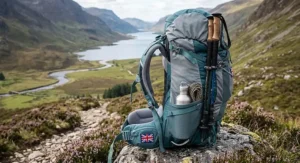
Women’s Fit Rucksack 50L: What Makes a Pack Truly Women’s-Specific
Fifty litres is the volume where the “women’s-specific” label earns its keep, because it’s the point most UK backpackers land on for a standard multi-day trip. But not every pack marketed as women’s-fit actually delivers meaningfully different engineering — sometimes it’s genuinely a shorter back length and reshaped harness (as with the Osprey Renn 50 or Gregory Deva 60), and sometimes it’s closer to a unisex pack in a different colourway.
The features that actually matter: S-shaped rather than J-shaped shoulder straps, which curve around the chest instead of pressing straight down; a hip belt that flares outward to wrap a more pronounced waist-to-hip ratio; and a shorter default back length range, typically starting several centimetres shorter than the equivalent men’s or unisex model. What most buyers overlook is that a genuinely well-fitted unisex pack can outperform a poorly-fitted women’s one — the label is a starting point for fit, not a guarantee of it, since internal frames are engineered to transfer load onto the hips regardless of the wearer’s body shape.
Adjustable Back Length Rucksack: Why It Matters More Than Litres
If there’s one spec worth obsessing over above all others, it’s back length adjustability, and it’s not close. A pack that’s the wrong back length for you will feel uncomfortable no matter how good the fabric, frame or price — the hip belt will sit too high or low, the shoulder straps will dig in at the wrong angle, and load lifters won’t be able to do their job. Systems vary considerably in precision: the Deuter Aircontact Lite 50+10 SL‘s VariQuick and the Osprey Kyte 46‘s sliding yoke both offer near-infinite fine adjustment, while the Vango Sherpa 60:70S and Eurohike Nepal 65 use simpler ladder or webbing systems that adjust in broader increments.
Here’s what most buyers overlook: a pack with excellent fine adjustment but the wrong base size range still won’t fit. Always check the stated back-length range in centimetres — for example, the Vango’s “S” model is specifically built for 46-56cm backs — rather than assuming “women’s” automatically means “will fit me.” Many UK outdoor retailers offer free in-store rucksack fitting specifically because getting this measurement wrong is the single most common cause of an uncomfortable multi-day carry.
Female Hiking Backpack vs Unisex Packs: The Real Differences
| Feature | Women’s-Specific Pack | Unisex Pack |
|---|---|---|
| Shoulder straps | S-shaped, curve around chest | Straight, J-shaped |
| Hip belt | Pre-curved, flared for hip-to-waist ratio | Straight profile |
| Back length range | Shorter default range | Longer average range |
| Best for | Shorter torsos, curvier build | Longer torsos, straighter build |
| Example | Gregory Deva 60 | Standard men’s Gregory Baltoro |
The table understates one important nuance: fit is about individual body shape far more than gender labelling. A shorter-torsoed man will often find a women’s pack like the Lowe Alpine Manaslu ND50:65 more comfortable than a standard unisex one, and a longer-backed woman may genuinely prefer a men’s or unisex design. The women’s-specific tag is best read as “shorter back length and curvier harness shape as standard,” not as a rule that applies universally — try before you buy where possible, and prioritise the measured fit over the marketing category on the box.
Common Mistakes When Buying a Women’s Backpacking Rucksack
Buying the wrong size is the single biggest and most avoidable mistake — guessing torso length from height, rather than actually measuring it, sends more people back to the returns queue than any other error. A close second is overbuying capacity “just in case,” which tempts you to fill the extra space with unnecessary weight; a 65L pack half-empty carries worse than a well-packed 50L one. Buyers also frequently skip trying the pack loaded, assuming an empty test-fit in a shop tells the whole story, when hip belt comfort only really reveals itself under real weight.
Another recurring pitfall: prioritising litres-per-pound value on a budget pack like the Eurohike Nepal 65 without accounting for how often it’ll actually be used — brilliant value for one expedition, less brilliant if it falls apart on the third. Finally, plenty of buyers ignore fabric water resistance ratings entirely and are then surprised when a “water-resistant” pack lets damp through on a genuinely wet UK weekend; a dry bag liner solves this cheaply regardless of which pack you choose.
✨ Ready to Find Your Perfect Fit?
🔍 Compare capacity, back length and price across all seven picks above, then check current stock and sizing before you commit. The right rucksack should disappear on your back — not remind you it’s there every step of the way!
Long-Term Cost & Maintenance
A rucksack’s real cost isn’t the price tag — it’s price divided by years of comfortable use. A £35 Eurohike Nepal 65 used for one DofE expedition and then retired is perfectly good value at roughly £35 per trip. The same pack used weekly for three years of serious hillwalking would likely need replacing well before an Osprey Kyte 46 bought for £200 and covered by a lifetime warranty, which could realistically outlast a decade of regular use at a genuinely lower cost-per-year.
Maintenance is straightforward but frequently skipped: hand-wash with a specialist technical wash rather than standard detergent, which can strip waterproof coatings; check zips and buckles for grit after muddy trips; and re-proof the fabric with a spray-on treatment once or twice a season if you’re using the pack regularly. Packs with metal frames, like the Gregory Deva 60 or Lowe Alpine Manaslu ND50:65, benefit from an occasional check of the frame sheet for any flex or damage, since that’s what’s doing the heavy lifting — literally — when you’re carrying 15kg-plus.
Women’s Trekking Gear: Building the Rest of Your Kit Around Your Rucksack
A rucksack is only as good as what’s going in and around it, and a few cheap additions solve problems that no pack, however well designed, fully addresses on its own. A dry bag liner (or simply a sturdy bin liner, doubled up) keeps kit dry inside packs like the Eurohike Nepal 65 that are water-resistant rather than waterproof. A rucksack rain cover, included with the Vango Sherpa 60:70S but sold separately for some other packs, protects external pockets and straps that a liner can’t reach.
Beyond waterproofing, women’s-specific trekking gear generally follows the same fit logic as the rucksack itself: hip belts and shoulder harnesses aside, a properly fitted pair of walking boots and moisture-wicking base layers matter just as much for a comfortable multi-day carry, since blisters and chafing from ill-fitting clothing will undo even the best-fitted pack. Trekking poles are worth considering for anyone carrying a heavier load like the Gregory Deva 60’s typical 15-18kg — they shift some strain from knees to arms on steep descents, a detail the Ramblers’ own walking essentials guidance flags as particularly useful for longer or hillier routes.
Safety, Regulations & Compliance Guide
For UK backpackers, the most relevant “regulation” isn’t legal but practical: recommended maximum load guidance. Physiotherapy and orthopaedic sources generally advise keeping total pack weight to somewhere between 10 and 20 percent of your body weight for sustained comfort, rising toward the upper end only for shorter trips or very fit, experienced carriers — a heavier pack than that increases the risk of shoulder, neck and lower back strain considerably. This is worth bearing in mind when choosing between, say, the ultralight Osprey Renn 50 and the heavier-duty Gregory Deva 60: buying more pack than you need “just in case” can ironically make a trip less safe if it tempts you to overpack.
For anyone doing a Duke of Edinburgh expedition specifically, rucksacks recommended by the scheme are expected to include a hi-vis waterproof cover, an adjustable back system, and padded, breathable straps as standard — all boxes ticked by the Vango Sherpa 60:70S and Eurohike Nepal 65 featured above. Whatever pack you choose, always carry it with both straps on your shoulders rather than slung over one side, keep the hip belt properly tightened so it — not your shoulders — bears most of the load, and take regular breaks on longer carries to avoid cumulative strain.
Frequently Asked Questions
❓ What size rucksack do I need for backpacking as a woman?
❓ How do I know my torso length for a women's rucksack?
❓ Is a women's specific rucksack really necessary?
❓ What's the best women's fit rucksack 50L for a first trip?
❓ How much weight should a women's backpacking rucksack carry?
Conclusion
There isn’t a single “best” women’s backpacking rucksack — there’s a best rucksack for your torso length, your trip length and your budget, and matching those three things correctly matters more than any single spec on a comparison table. If you’re taking your first steps into multi-day walking, the Vango Sherpa 60:70S or Eurohike Nepal 65 let you find out whether backpacking suits you without a big financial commitment. If you already know it does and you’re after genuine long-term comfort, the Osprey Kyte 46, Osprey Renn 50, Deuter Aircontact Lite 50+10 SL and Lowe Alpine Manaslu ND50:65 all offer real, adjustable, women’s-specific fit systems worth the extra spend. And if heavy, long-haul carrying is genuinely on the cards, the Gregory Deva 60‘s load-bearing engineering earns its premium price.
Whichever you choose, get the torso measurement right before anything else, load it up before your first proper hike, and adjust the hip belt properly — that one habit does more for comfort than upgrading to a pricier pack ever will.
✨ Don’t Miss These Exclusive Deals!
🔍 Take your search for the perfect women’s backpacking rucksack further with these carefully selected picks above. Click through to check current pricing and availability on Amazon UK — the right pack will make every mile that bit easier to enjoy!
Recommended for You
- Ryanair Cabin Bag Rucksack: 7 Best Picks to Fly Free in 2026
- Best 70L Rucksack for Hiking 2026: 7 Tried-and-Tested Winners
- Best 55L Rucksack 2026: 7 Top Picks for Every Budget
Disclaimer: This article contains affiliate links. As an Amazon Associate, I earn from qualifying purchases. If you purchase products through these links, we may earn a small commission at no additional cost to you.
✨ Found this helpful? Share it with your friends! 💬🤗
