
In This Article
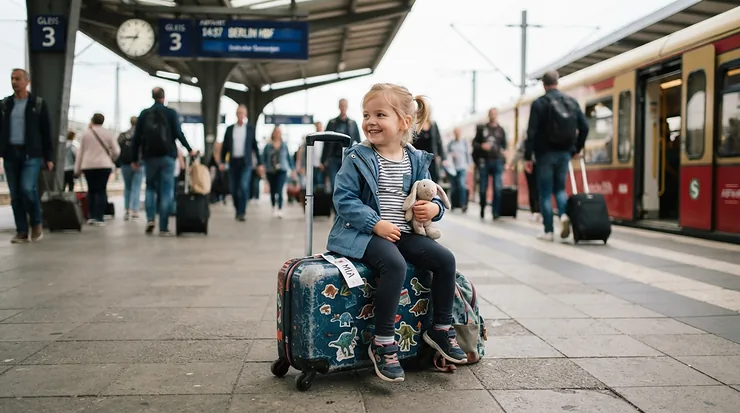
Picture the scene. You’ve cleared bag drop, the gate is a ten-minute march away, and your three-year-old has just discovered that legs are optional. This is the moment a ride-on kids suitcase earns its keep. It’s a hard-shell case holding a day’s worth of toddler essentials, with a sturdy shape on top. Your child rides while you steer.
The idea isn’t new. The original ride-on case launched in 2006 and spawned a whole category of imitators. In 2026 the choice is wider than ever: classic straddle-style cases, scooter hybrids, seat-top carry-ons, and even a case that doubles as an in-flight bed. Wider choice also means more ways to buy the wrong thing. Some are brilliant for a three-year-old and pointless for a six-year-old. Others look cabin-friendly on the listing, then fail the bag sizer at the gate.
This guide compares seven real ride-on kids suitcase options on the UK market, from budget to premium. It’s built on manufacturer specifications, UK retailer listings and published reviews, not hands-on testing, and I’ll say so wherever the evidence is thin. You’ll also find straight talk on hand luggage for young children, practical advice on airport queuing, and a decision framework you can use in two minutes.
Allowances, weight limits and prices all change, so confirm the details with your airline and retailer before you fly.
Quick Comparison: The Best Ride-On Kids Suitcase Options at a Glance
| Product | Ride style | Stated age | Best For |
|---|---|---|---|
| Trunki Ride-On Suitcase | Straddle-and-tow | 3–6 years | First-time buyers on a budget |
| IT Luggage Trunkryder | Straddle-and-tow with footrests | 3+ | Families wanting more packing space |
| VEVOR Ride-On Luggage 26L | Ride, tow or carry | 3+ | Budget buyers who need capacity |
| Mini Micro Suitcase Scooter | Stand-and-scoot | 2–6 years | Confident, active scooter fans |
| Micro Eazy Allrounder | Seated ride-on that converts to a pushchair | 18 months+ | Parents who’d otherwise pack a buggy |
| Stokke JetKids BedBox | Ride-on plus in-flight bed | 2–7 years | Long-haul flights |
| MiaMily Carry On | Seat-top carry-on | 2+ (with seat belt) | Families sharing one big cabin case |
Read this table by ride style first and price second. A stand-and-scoot case and a seat-top carry-on solve completely different problems. The Trunki Ride-On Suitcase and IT Luggage Trunkryder sit at the simple end, while the Micro Eazy Allrounder, MiaMily Carry On and Stokke JetKids BedBox offer the most support, at higher prices. Anyone shopping for hand luggage for young children on a budget should note that VEVOR Ride-On Luggage 26L trades polish for space.
💬 Just one click — help others make better buying decisions too!😊
Top 7 Ride-On Kids Suitcase Picks: Expert Analysis
Each pick below gets the same treatment: what the specs mean in practice, who it suits, what reviewers consistently say, and whether the price range makes sense.
1. Trunki Ride-On Suitcase — the classic, lightweight starter case
The Trunki Ride-On Suitcase taught a generation of toddlers to treat luggage as a vehicle, with its rounded shell, two grippy horns and straddle-friendly shape. The brand lists 18 litres, roughly 46 × 20.5 × 31 cm, 1.7 kg and a 50 kg maximum ride-on load, aimed at ages 3 to 6. That 50 kg rating is far beyond what a preschooler weighs, so the real limit is leg length, not strength. At 1.7 kg you can tuck it under one arm when your rider mutinies.
Based on the spec comparison, this is a ride-on suitcase for toddlers and preschoolers on short-haul trips, with one adult managing the tow strap. Eighteen litres is a few changes of clothes, not a fortnight in Crete. On paper its length and depth sit within a whisker of easyJet’s free 45 × 36 × 20 cm under-seat limit, so measure rather than assume. A published Expert Reviews verdict praised the locking fasteners, tow strap and wide-set wheels, but marked it down for modest space and a fiddly internal clasp.
Reviewers across buying guides are consistently warm about it. The recurring complaint is that children outgrow it quickly.
Pros:
- ✅ Lightweight at about 1.7 kg
- ✅ Sturdy locking fasteners and tow strap
- ✅ Huge range of character designs
Cons:
- ❌ Only 18 litres of packing space
- ❌ Most children outgrow it by five or six
Typically around £40–£50 depending on design, which is strong value if you’ll take several trips in the peak years.
2. IT Luggage Trunkryder — roomiest cabin-size shell for the money
Where the Trunki Ride-On Suitcase is compact, the IT Luggage Trunkryder goes large. The brand lists a 54 × 34 × 25 cm hard ABS shell with 41 litres of space at 2.68 kg. That’s more than double the packing room, which matters when you’re also carrying a child’s coat, wipes and a full change of clothes. Listings mention footrests, a child-friendly tow handle, four internal pockets and a 10-year guarantee, which is long for children’s luggage.
One spec deserves a flag. A UK retailer lists a maximum ride-on weight of 23 kg, less than half the Trunki rating. Most preschoolers will sit comfortably inside that cap, but older or taller children won’t, so check your child’s weight. Brand copy says it fits cabin restrictions for several UK airlines, yet at 54 cm long it’s an overhead-locker size, not an under-seat one. On budget carriers that usually means a paid cabin bag.
I couldn’t verify a deep pool of independent UK reviews, so treat feature claims as brand-stated. Expert Reviews does list it as a similarly priced alternative to the Trunki.
Pros:
- ✅ 41 litres, roughly double the classic rivals
- ✅ Long 10-year guarantee
- ✅ Footrests and child-friendly tow handle
Cons:
- ❌ Lower 23 kg ride-on limit
- ❌ Overhead-locker size, not under-seat
Around £30–£45 across retailers, which is excellent value for the space.
3. VEVOR Ride-On Luggage 26L — budget storage with a sturdy weight rating
The VEVOR Ride-On Luggage 26L is the pragmatic pick. It has an ABS and polycarbonate shell, 26 litres, about 2.1 kg and a 110 lb (roughly 50 kg) weight limit. It offers ride, tow and carry modes plus an adjustable shoulder strap. Listing dimensions of roughly 47 × 27.5 × 37 cm tell the real story: it’s chunkier than the Trunki Ride-On Suitcase, with more volume but a taller, wider profile. That depth is more than the 25 cm common on large cabin bags, so check the size rules before relying on it.
Analytically, it suits the parent who needs space and a robust weight rating on a tight budget, and who doesn’t mind a themed design. Roundups describe stable handling and generous storage. Their stated limitations are a bulky profile and wheels that don’t fold away. The brand is known mainly for workshop gear rather than children’s luggage, so check UK delivery, returns and seller details on the listing before buying, as availability varies.
Pros:
- ✅ 26 litres at a budget price
- ✅ Ride, tow and carry modes
- ✅ Generous 110 lb weight limit
Cons:
- ❌ Bulky profile won’t suit under-seat use
- ❌ Wheels don’t fold away
US buying guides place it in the budget bracket, so expect roughly £35–£60 in the UK. That’s good value on paper if the dimensions suit your airline.
4. Mini Micro Suitcase Scooter — scooter-style freedom for confident riders
The Mini Micro Suitcase Scooter flips the idea. Children don’t sit; they stand on a fold-out deck and kick. The maker lists ages 2–6, a 50 kg rider limit, 13 litres, 3.3 kg, a 50 × 29 × 28 cm cabin-size case and three handlebar heights from 49 to 70 cm, with a 2-year warranty. Retailer descriptions say the deck sits flush when folded, so internal space isn’t compromised. Thirteen litres is a day’s essentials for one child, not a week’s wardrobe.
Here’s the honest take: it only works if your child can already scoot. A tired two-year-old can’t ride it like a seat, which makes it the wrong tool for a sit-on kids case job. It rewards active, independent children and suits a preschooler with a scooter at home. The maker’s own safety advisory recommends helmets and smooth, dry surfaces, worth remembering on busy concourses.
Retailers call it popular, but I couldn’t verify a large independent review pool, so lean on the spec sheet. The maker’s own store advertises a 28-day free return window, which softens the risk.
Pros:
- ✅ Kids can scoot independently
- ✅ Compact, cabin-size shell
- ✅ Adjustable handlebar for ages 2–6
Cons:
- ❌ Only 13 litres of storage
- ❌ Not a seat for tired legs
Around £100–£110 at full price, which is premium money and justified only if scooting suits your child.
5. Micro Eazy Allrounder — ride-on, cabin case and pushchair in one
The Micro Eazy Allrounder replaces two things you’d otherwise carry: a buggy and a kids’ case. The maker lists suitability from 18 months, a 20 kg maximum load, 22–26 litres, 4 kg and a folded size of roughly 60 × 44 × 27 cm. The seat detaches to form a lightweight pushchair, and the handlebar adjusts from about 85 to 109 cm. The 20 kg cap is the key spec. It’s well below the Trunki Ride-On Suitcase rating, which tells you this is a toddler-and-preschool product.
The folded 60 cm length is longer than the 56 cm cabin limit often quoted for hand luggage. The maker says it should be accepted by airlines, but confirm with yours. At 4 kg it’s the heaviest of the compact options, yet it’s the only pick here with a true pushchair mode. That changes how you handle naps and cobbled streets at your destination.
On the maker’s own US store, reviewers describe it as a game-changer for toddler toddler travel comfort, though one parent noted that folding the wheels takes practice and that their child was nearing the weight limit around age five. Brand-site reviews skew positive, so weigh them accordingly.
Pros:
- ✅ Doubles as a lightweight pushchair
- ✅ Seated ride from 18 months
- ✅ Adjustable handlebar height
Cons:
- ❌ 20 kg limit means a shorter lifespan
- ❌ Heaviest compact pick, so check airline fit
Around £120–£150, which is worthwhile if it genuinely replaces a buggy.

6. Stokke JetKids BedBox — turns an airline seat into a bed
The Stokke JetKids BedBox is the long-haul specialist: ride-on case by day, in-flight bed by night. Listings give about 46 × 20 × 36 cm, roughly 20 litres, 3.3 kg and a 35 kg limit. The maker recommends the ride-on feature for roughly ages 3–7 and the bed from age 2, because it needs a full seat. Soft side panels and an extending lid create a flat surface across the seat. Retail care notes say the mattress is machine washable at 30°C.
The bed only matters if your child has their own seat and your airline allows its use, so check the maker’s airline approval list first. One UK retailer states that British Airways has approved it. A tester noted that it’s heavier than standard kids’ cases, and that replacement parts are less widely available than for UK-based rivals. Another roundup flagged that it isn’t approved on some airlines.
Published reviews describe a smooth, sturdy ride. One parent reviewer awarded top marks for the design and the dual function, a rare example of toddler travel comfort driving the purchase.
Pros:
- ✅ Doubles as an in-flight bed
- ✅ Sturdy ride-on for a wide age range
- ✅ Washable mattress
Cons:
- ❌ Heavier and costlier than most rivals
- ❌ Not approved on every airline
Roughly £130–£190 depending on retailer and colour, which is pricey but strong value on overnight flights.
7. MiaMily Carry On — adult-size case with a built-in seat
The MiaMily Carry On is a different animal: an adult-size hard-shell cabin case with a foldable seat in the top. A child can ride while you wheel it, or an adult can perch at a crowded gate. Listings cite 43 litres, a seat belt, a TSA-style lock, four double spinner wheels and a footprint around 19 × 15 × 11.5 inches (about 48 × 38 × 29 cm). It’s a family-size case, so overhead-locker only on most airlines. Some listings quote adult-rated seat limits (one cites 220 lb on a Plus version), but limits vary by model, so check yours.
This is ideal when one parent wants a single shared case, with a sit-on kids case function bolted on. It also needs rules: retailer guidance says only one child at a time, hands on the luggage and the belt fastened. It isn’t a toy.
Published roundups quote parents saying children find it easy to pull and ride, and enjoy owning their bit of the journey. Price is the sticking point, and UK stock varies by retailer.
Pros:
- ✅ Seat works for kids and adults
- ✅ 43 litres of packing space
- ✅ Seat belt and spinner wheels
Cons:
- ❌ Premium pricing
- ❌ Too large for under-seat use
US listings sit around the $359 mark, so expect well above £200 in the UK and check current availability. It’s worthwhile only if one big shared case suits your family.
Spec and Price Comparison
| Product | Capacity | Stated max load | Approx. price range | Best For |
|---|---|---|---|---|
| Trunki Ride-On Suitcase | 18 L | 50 kg | £40–£50 | First trips, ages 3–5 |
| IT Luggage Trunkryder | 41 L | 23 kg | £30–£45 | Extra packing space |
| VEVOR Ride-On Luggage 26L | 26 L | 50 kg (110 lb) | £35–£60 | Budget capacity |
| Mini Micro Suitcase Scooter | 13 L | 50 kg | £100–£110 | Active scooter fans |
| Micro Eazy Allrounder | 22–26 L | 20 kg | £120–£150 | Buggy replacement |
| Stokke JetKids BedBox | About 20 L | 35 kg | £130–£190 | Long-haul sleep |
| MiaMily Carry On | 43 L | Varies by model | £200+ | One shared family case |
Notice how little the price tracks the weight limit. The Trunki Ride-On Suitcase and VEVOR Ride-On Luggage 26L share a 50 kg rating at the bottom of the price range, while the Micro Eazy Allrounder caps at 20 kg but costs several times more. What you pay extra for is function: pushchair mode, a bed, or an adult seat. If your child just needs somewhere to sit between check-in and the gate, the cheaper cases already do the job.
What Is a Ride-On Kids Suitcase?
A ride-on kids suitcase is a hard-shell case built strong enough for a young child to sit on while an adult tows it along. It pairs packing space with transport, so a tired toddler rides through the terminal while snacks, spare clothes and a comfort toy travel with them.
That definition covers more variety than you’d think. A ride-on suitcase for toddlers usually means the straddle-style shell with horns, like the Trunki Ride-On Suitcase. A sit-on kids case swaps the saddle for a flat seat or lid, as with the MiaMily Carry On and the Micro Eazy Allrounder. Scooter hybrids such as the Mini Micro Suitcase Scooter have the child stand instead, and the Stokke JetKids BedBox adds a sleeping function.
Together these form the ride-on airport luggage category: cases designed for the terminal rather than the classroom. What they share is a promise of less carrying, fewer meltdowns and a child who feels like captain of their own bag. What differs is how long that promise lasts, which depends on stated ages, weight limits and size.
How to Choose a Ride-On Kids Suitcase
Choosing a ride-on kids suitcase comes down to seven checks. Work through them in order and your shortlist usually shrinks to two.
- Match the ride style to your child’s skills. A seated ride suits a tired two-year-old, while a stand-and-scoot design needs a child who can already balance.
- Check the weight limit, not just the age. Limits run from 20 kg on the Micro Eazy Allrounder to 50 kg on the Trunki Ride-On Suitcase, and that gap decides how many years of use you get.
- Measure against your airline. Free under-seat sizes are small (45 × 36 × 20 cm at easyJet, at the time of research), and bigger overhead allowances are often paid.
- Decide who carries the packing. A 13-litre case holds one child’s essentials, whereas the 41-litre IT Luggage Trunkryder or 43-litre MiaMily Carry On can carry more of the family’s kit.
- Think about the floor. Hard four-wheel designs glide across terminal floors but struggle on cobbles and kerbs.
- Compare locks, belts and guarantees. Guarantees run from 2 years on the Mini Micro Suitcase Scooter to 10 years on the IT Luggage Trunkryder, which says something about expected durability.
- Estimate the useful life. If your child is already four, a case with a 3–6 window gives you roughly two seasons, so work out the cost per trip.
Ride-On Airport Luggage vs a Standard Kids’ Wheeled Case
| Feature | Ride-on airport luggage | Standard kids’ wheeled case |
|---|---|---|
| Tired-legs rescue | Child can ride or scoot | None; you carry the child |
| Packing space | Roughly 13–43 L | Often around 25–30 L |
| Useful lifespan | Typically up to about age 5–7 | Often into the “tween” years |
| Typical price | Around £30–£190+ | Around £25–£60 |
| Best For | Trunki Ride-On Suitcase, Stokke JetKids BedBox, Micro Eazy Allrounder | Older children wanting a “proper” suitcase |
The table hides a simple trade-off: ride-on cases buy you transport now, while standard cases buy you longevity later. A telescopic-handle kids’ case costs less and often lasts into the tween years, but it won’t carry a flagging three-year-old across Terminal 2. Expert Reviews makes the same point, noting that children aspire to a “proper” wheeled case once they’re past four or five. A ride-on kids suitcase wins when your child is under about five and you’ll face several long terminal walks. Beyond that, a conventional case usually represents better long-term value.
Hand Luggage for Young Children: Airline Rules and Fit
Hand luggage for young children is where good intentions meet cold, hard bag sizers. Allowances differ by airline, by fare and sometimes by whether your child holds their own seat. Which?’s guide to airline cabin allowances is a handy cross-check. At the time of research, easyJet’s free under-seat bag was 45 × 36 × 20 cm including wheels and handles, with a larger 56 × 45 × 25 cm cabin bag available as a paid or upgraded allowance. Ryanair’s free bag is smaller, around 40 × 20 × 25 cm, and the airline has been adjusting its underseat size, so check the latest. Jet2 lists a 10 kg hand luggage allowance (excluding infants) plus a small under-seat bag.
Against those numbers, here’s the honest fit. The Trunki Ride-On Suitcase is the only pick close to under-seat territory, and even then it’s borderline. The Mini Micro Suitcase Scooter, IT Luggage Trunkryder, VEVOR Ride-On Luggage 26L, Stokke JetKids BedBox and MiaMily Carry On are overhead-locker propositions on listed dimensions. The folded Micro Eazy Allrounder is quoted longer than the common 56 cm limit, so confirm before you fly. One more catch: if your toddler is a lap infant, they may have no allowance of their own, so the case could count as your item.
Your First 30 Days With a Ride-On Kids Suitcase: Setup, Care and Habits
Treat the first month as a pilot scheme, because a few weeks of practice at home beats improvising at security.
Week one: learn the rules. Let your child ride on carpet and hard floor. Teach both hands on the grips, one rider only, and no riding on escalators, slopes or stairs. A sit-on kids case is a moving vehicle, so supervision matters.
Week two: pack it for real. Put heavy items low and central, because a top-heavy case tips. Weigh the loaded case on the bathroom scales and add your child’s weight to check you’re inside the stated limit. That’s 23 kg on the IT Luggage Trunkryder and 20 kg on the Micro Eazy Allrounder.
Week three: test the hardware. Check strap clips, fasteners and locks. Wipe the shell, clear grit from the wheels and tuck a luggage tag with your mobile number inside.
Week four: rehearse. Take a dry run to a local station or shopping centre to practise your airport queuing choreography.
The common first-month mistakes are overpacking, skipping the weight check, and letting the case become a toy that gets dragged down stairs. Avoid all three and the shell should look respectable for years.
Real-World Scenarios: Which Ride-On Kids Suitcase Fits Which Family?
Profile 1: the budget short-hauler. A family of four, a long weekend, one cabin item each on a budget carrier, and £50 set aside for the child’s case. With a three-year-old and two trips a year, the Trunki Ride-On Suitcase is the natural starting point, provided you measure it against the airline’s rules. If you’re already paying for cabin bags, the IT Luggage Trunkryder offers far more space for similar money.
Profile 2: the long-haul flyer. A five-year-old, a nine-hour flight, one big trip a year and a budget near £150. The Stokke JetKids BedBox is built for this, but only if your airline lists it as approved and your child has their own seat. The cost per trip is high, though a sleeping child is priceless.
Profile 3: the city-breaker without a buggy. A 20-month-old, three city breaks a year, cobbled streets and a budget around £130. The Micro Eazy Allrounder covers the ride-on suitcase for toddlers role at the airport, then converts to a pushchair on arrival. Check the folded size against your airline, and plan for a shorter lifespan given its 20 kg limit.
✨ Ready to Make Airports Easier?
🔍 Take your next family trip to the next level with these carefully selected cases. Click on any highlighted product name to check current pricing and availability. A well-chosen ride-on kids suitcase could save you a lot of carrying and a few meltdowns! 🧳😊

Airport Queuing With a Toddler: Problems and Solutions
Airport queuing is where toddlers and parents both test their limits. Here’s how a ride-on kids suitcase can help, problem by problem.
Problem 1: the bag-drop line that never moves. Standing still is torture for a three-year-old. Let them ride and shuffle the case forward with the tow strap, and keep snacks in an outer pocket so there’s something to do.
Problem 2: the security tray shuffle. You, a child, a case and a liquids bag all need processing at once. GOV.UK’s liquids rules explain the usual 100ml limit, which some airports have relaxed, so check your departure airport. Read the page for exceptions, including medical and dietary needs. Pre-pack liquids in a clear bag within easy reach and expect to lift the case onto the belt while your child walks through.
Problem 3: the endless gate walk. This is where ride-on airport luggage shines. Let your child ride the long corridors, then dismount for the last stretch before boarding.
Problem 4: the boarding squeeze. Detach the strap, fold any seat or handlebar, and have your child walk on. Airport queuing goes more smoothly when the case stops being a vehicle and becomes baggage again.
Toddler Travel Comfort: What to Expect in Real Life
Toddler travel comfort isn’t about the case alone. It’s about how the whole journey feels from a 90 cm vantage point. Most straddle-style cases are firm hard plastic, so they suit short hops rather than hour-long rides. Padded options differ: published roundups mention a small padded seat and belt on the MiaMily Carry On, while the Trunki Ride-On Suitcase relies on its saddle shape and horns.
Footrests, as listed on the IT Luggage Trunkryder, help legs stay comfortable and stable. Rest matters too. The Micro Eazy Allrounder converts to a pushchair for naps, and the Stokke JetKids BedBox creates a flat sleeping surface across an airline seat, subject to airline approval.
Small things add up. Keep a comfort toy and a drink in reach, and let your child dismount regularly. If you only remember one rule for sit-on kids case rides, make it this: little and often beats long and relentless.
Features That Actually Matter (And Those That Don’t)
What matters:
- Weight limit versus your child’s weight. This decides lifespan.
- Packed dimensions. They decide whether you pay a cabin bag fee.
- Wheel quality and stability. Wide-set wheels mean fewer topples.
- Tow handle design. A child-friendly grip lets them join in.
- Guarantee length. It ranges from 2 to 10 years across these picks.
What doesn’t:
- TSA-style locks matter little on UK domestic or European trips, though they’re handy for US-bound journeys.
- Character designs are fun but cosmetic, and they won’t change how the case performs.
- LED wheels look lovely, but they’re unlikely to improve safety on their own.
The best ride-on kids suitcase isn’t the one with the most features. It’s the one that matches your child’s age, your airline’s rules and your budget.
Common Mistakes When Buying a Ride-On Kids Suitcase
- Assuming every ride-on case is cabin-legal everywhere. Dimensions and fares differ, so measure first, especially when buying hand luggage for young children.
- Buying too big, too soon. A 13-year-old size isn’t needed; a three-year-old needs something they can climb on and steer.
- Ignoring weight limits. A 20 kg cap versus a 50 kg cap changes how long the case lasts.
- Forgetting who carries it. A ride-on suitcase for toddlers still needs an adult to pull it for much of the journey.
- Skipping the airline approval check. This matters most for the Stokke JetKids BedBox, whose bed feature depends on airline permission.
- Treating it as a toy. A sit-on kids case isn’t for escalators, slopes or stairs.
- Skipping the practice run. Rehearsing at home saves stress at security.
Long-Term Cost & Maintenance: Cost Per Trip
Value is cost spread across use. Working from the price ranges above and an assumed six trips, here’s how it breaks down.
| Product | Price range | Stated useful window | Rough cost per trip (6 trips) | Value verdict |
|---|---|---|---|---|
| Trunki Ride-On Suitcase | £40–£50 | Ages 3–6 | About £7–£8 | Strong value |
| IT Luggage Trunkryder | £30–£45 | Ages 3+ (23 kg cap) | About £5–£8 | Excellent for space |
| VEVOR Ride-On Luggage 26L | £35–£60 | Ages 3+ | About £6–£10 | Good if size fits |
| Mini Micro Suitcase Scooter | £100–£110 | Ages 2–6 | About £17–£18 | Premium |
| Micro Eazy Allrounder | £120–£150 | 18 months+ (20 kg cap) | About £20–£25 | Worth it if it replaces a buggy |
| Stokke JetKids BedBox | £130–£190 | Ages 2–7 | About £22–£32 | Best on long-haul |
| MiaMily Carry On | £200+ | Family use | About £40+ | Only if shared |
The cost-per-trip picture is stark. The budget picks cost well under £10 a trip over six journeys, while the premium options sit at £20 or more. That isn’t a verdict against them; the Stokke JetKids BedBox earns its price on overnight flights, and the Micro Eazy Allrounder pays back if it replaces a buggy you’d otherwise buy or carry. For maintenance, wipe shells with a damp cloth, keep wheels clear of grit and store the case with its strap. One tester noted replacement parts are less widely available for the Stokke JetKids BedBox than for UK-based rivals, which is worth weighing against its premium price.
FAQ
❓ What age is a ride-on suitcase for toddlers suitable for?
❓ Can a ride-on kids suitcase go in hand luggage?
❓ Is a sit-on kids case safe for toddlers?
❓ Is ride-on airport luggage worth it compared with a buggy?
❓ How much does a ride-on kids suitcase cost in the UK?
Conclusion
A ride-on kids suitcase won’t make a flight easy, but it can make the awkward bits of an airport day more manageable and a lot more fun. For most families with under-fives, the Trunki Ride-On Suitcase is the sensible starting point: light, proven and affordable. If you need more space, the IT Luggage Trunkryder offers 41 litres for similar money, and the VEVOR Ride-On Luggage 26L gives budget buyers a high weight rating, provided its dimensions suit your airline.
Spend more only when the extra function earns its keep. The Stokke JetKids BedBox suits long-haul flights, the Micro Eazy Allrounder can stand in for a buggy, the Mini Micro Suitcase Scooter rewards confident scooters, and the MiaMily Carry On suits families who’d rather share one large case. Whichever you choose, check the weight limit, measure against your airline’s rules, and practise at home first. A sit-on kids case is a small piece of kit, but the right one can make airport queuing, long gate walks and toddler travel comfort a whole lot kinder to everyone.
Recommended for You
- Kids Luggage Set For Holidays: 7 Best Picks For UK Families (2026)
- Best Kids Luggage: 7 Brilliant Picks For UK Families (2026)
- Convertible Laptop Bag For Commuting: 7 Best Picks (2026)
Disclaimer: This article contains affiliate links. As an Amazon Associate, I earn from qualifying purchases. If you purchase products through these links, we may earn a small commission at no additional cost to you.
✨ Found this helpful? Share it with your friends! 💬🤗
