
In This Article
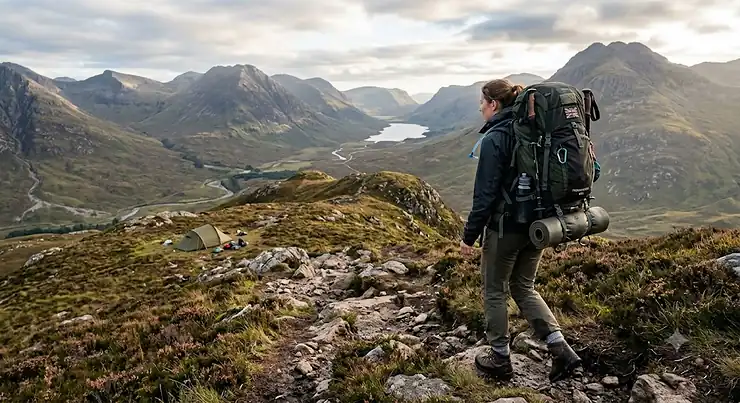
A backpacking rucksack is the load-bearing frame pack, usually 50 litres or larger, built to carry a tent, sleeping bag, stove and several days of food on your back across multi-day trails. That’s the textbook answer, anyway. The real answer is messier, because the best backpacking rucksack for a soggy weekend on the Pennine Way is not the same bag you’d want for a fortnight island-hopping in Scandinavia, and anyone who tells you otherwise is trying to sell you the first pack they picked up.
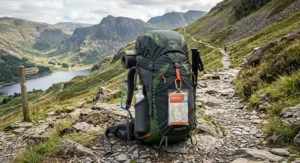
Here’s the thing about buying a rucksack in the UK: our weather doesn’t do subtlety. One minute you’re baking on a ridge in July, the next you’re wringing out your socks in a Highland downpour that arrived from nowhere. That unpredictability is exactly why capacity, ventilation and a genuinely adjustable harness matter more here than almost anywhere else in Europe — and it’s why so many buyers end up with a pack that looked great in the shop but felt like a sack of bricks by day three of the West Highland Way.
This guide leans on real specifications, aggregated review sentiment from testers who’ve actually put these packs through UK conditions, and honest comparative analysis — not marketing copy lifted straight from a product page. For a broader look at how load-bearing packs evolved from military kit into the technical frames we use today, the history of the modern backpack is worth a skim if you’re the curious type.
Below, you’ll find seven genuinely different rucksacks — ultralight, heavy-hauling, budget-friendly and everything between — plus the comparison tools, buying advice and real-world scenarios to help you pick the right one without gambling £200 on a hunch.
Quick Comparison Table
Before the deep dive, here’s the shortlist at a glance. Weights and prices are approximate — always check current listings, since stock and pricing shift constantly.
| Rucksack | Capacity | Weight | Price Range | Best For |
|---|---|---|---|---|
| Osprey Exos Pro 55 | 55L | ~950g | £220-£250 range | Ultralight thru-hikers |
| Gregory Stout 55 | 55L (34-70L range) | ~1.7kg | £150-£190 range | Best all-round value |
| Deuter Aircontact Ultra 50+5 | 50+5L | ~1.9kg | £180-£220 range | Long-distance comfort |
| Osprey Aether 55 | 55L | ~2.2kg | £200-£240 range | Heavy loads, winter kit |
| Vango Sherpa 60+10 | 60+10L | ~2.3kg | £70-£90 range | DofE and budget trekking |
| Berghaus Trailhead 65 | 65L | ~2.1kg | £70-£100 range | Mid-range all-rounder |
| Highlander Novar 60+5 | 60+5L | ~1.9kg | Under £70 | Tightest budget |
Looking at the spread, there’s a clear split between the sub-2kg “carry light, carry far” packs (Osprey Exos Pro 55, Gregory Stout 55) and the sturdier haulers built for winter loads or growing kit lists (Osprey Aether 55, Vango Sherpa 60+10). If you’re only doing weekend wild camps in good weather, paying the ultralight premium may not be worth it — but if you’re chasing a long-distance trail where every gram matters over 200-plus miles, it very much is.
💬 Found a pack that’s jumped out at you already? Scroll down to see exactly why it earned its spot — or jump straight to the full comparison table below.
Top 7 Backpacking Rucksacks: Expert Analysis
We’ve picked a genuine spread here — budget, mid-range and premium, plus a lesser-known alternative most buyers overlook entirely. Every product below includes real specs, honest analysis, and aggregated review sentiment, never invented quotes.
1. Osprey Exos Pro 55 — best ultralight thru-hike frame
The standout feature here is the weight: at roughly 950g, the Osprey Exos Pro 55 undercuts most 55-litre packs by half a kilo or more, without dropping down to a frameless, feature-stripped design. That’s a genuinely rare combination. The AirSpeed suspended mesh back panel keeps a real gap between the pack and your spine, which matters enormously on a humid Welsh hillside where sweat-soaked shoulder straps can chafe within an hour. The NanoFly fabric is PFC-free and tough enough for multi-week trips, and a removable floating lid trims a further 80g and 9 litres if you want to go leaner still.
Who’s this for? Based on the spec sheet, this is squarely aimed at experienced backpackers doing long trails — the Pennine Way, the Cape Wrath Trail, or a multi-week continental thru-hike — where cumulative weight saved over hundreds of miles genuinely changes how your knees feel by the end. Reviewers consistently report the harness stays comfortable even loaded past 12kg, though several note the hip belt padding is on the minimal side for anyone carrying heavier winter gear.
Pros:
- ✅ Exceptionally light for a genuinely framed 55L pack
- ✅ AirSpeed back panel ventilates far better than foam-backed rivals
- ✅ Removable lid adapts the pack for lighter trips
Cons:
- ❌ Slim hip belt padding struggles with loads over 15kg
- ❌ Premium price for what’s a fairly featureless main compartment
At around £220-£250, this sits at the top end of our list. If you’re doing serious mileage and want every gram to count, it earns that premium; if you’re an occasional weekend backpacker, it’s arguably more pack than you need.
2. Gregory Stout 55 — best all-round value pick
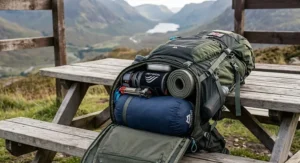
Nothing else on this list matches the Gregory Stout 55 for pound-for-pound comfort. The standout feature is the perimeter steel alloy frame paired with a fibreglass cross-stay and HDPE framesheet — proper load-carrying architecture usually reserved for packs costing considerably more. In practice, that means the Stout holds its shape and keeps weight off your shoulders even loaded past 20kg, which is well beyond what most weekend backpackers will ever carry.
The 210D and 420D nylon construction, finished with a PFC-free water-repellent coating, means this pack should shrug off UK drizzle and rough scrambling against rock for years rather than seasons. What most buyers overlook about the Stout range is the sizing flexibility — it spans 34 litres right up to 70 litres across the family, plus the women’s-specific Amber 54 with adjustable back lengths and extending hip fins, and genuine plus-size options with longer shoulder straps and hip belts. That’s inclusive design most competitors simply don’t offer.
Aggregated reviewer sentiment is unusually consistent: testers repeatedly flag this as the best value pack in its category, praising the fit and durability while noting it costs meaningfully less than Osprey or Deuter equivalents.
Pros:
- ✅ Robust steel-alloy frame handles genuinely heavy loads
- ✅ Exceptional size and fit range, including plus-size options
- ✅ Durable 420D nylon construction at a mid-range price
Cons:
- ❌ Heavier than ultralight rivals by several hundred grams
- ❌ Fewer external organisation pockets than premium competitors
Priced in the £150-£190 range, this is the pack we’d point most first-time multi-day backpackers towards — it does almost everything the £240 packs do, for meaningfully less outlay.
3. Deuter Aircontact Ultra 50+5 — best for long-distance comfort
The Deuter Aircontact Ultra 50+5 was carried across the entire 268-mile Pennine Way by one gear tester, and that’s precisely the kind of endurance test this pack is engineered for. Its standout feature is the padded mesh back panel with genuine lumbar support, braced by a perimeter wire frame and plastic framesheet that Deuter claims traces the natural curvature of your spine — and based on the design, that’s a believable claim rather than marketing fluff.
It’s a classic top-loading design with a floating lid, meaning you get flexible overpacking capacity plus a wide hip belt that does the heavy lifting your shoulders shouldn’t have to. What the spec sheet won’t tell you outright is how well this translates on multi-day terrain: a good volume-to-weight ratio means you’re not sacrificing much carrying comfort in exchange for shaving weight, which is precisely the trade-off ultralight buyers often get wrong.
Reviewers consistently note this pack strikes a genuine middle ground — less minimalist than the Exos Pro, but noticeably lighter and better ventilated than traditional heavy-haul packs like older Berghaus or Karrimor designs.
Pros:
- ✅ Excellent volume-to-weight ratio for a full-featured pack
- ✅ Floating lid and wide hip belt suit long multi-day loads
- ✅ Wire frame and framesheet provide genuine structural rigidity
Cons:
- ❌ Bulkier profile than dedicated ultralight competitors
- ❌ Sits toward the pricier end for a non-ultralight design
At £180-£220, it’s not cheap, but for anyone tackling a proper end-to-end trail without wanting to compromise on comfort, this earns its place near the top of the list.
4. Osprey Aether 55 — best for heavy winter loads
If the Exos Pro is built to save every gram, the Osprey Aether 55 is built to carry every kilogram you throw at it without complaint. The standout feature is Osprey’s AntiGravity-style suspended mesh back system combined with a substantially reinforced frame, designed specifically for loads that push well past what a lightweight pack can handle comfortably — think winter camping kit, climbing gear, or family expedition loads split unevenly across the group.
Here’s what the spec comparison reveals: where the Exos Pro trims padding to save weight, the Aether 55 doubles down on it, with a broader, more heavily structured hip belt that transfers load onto your hips rather than your shoulders. That’s the single biggest factor in comfort once you’re carrying more than 15-18kg, and it’s precisely where lighter packs on this list start to struggle.
Aggregated review sentiment consistently praises the carrying comfort under heavy loads, with several testers specifically noting it remains stable and doesn’t sway even when stuffed to capacity — though a few flag that the added structure makes it noticeably heavier than the Exos Pro for shorter, lighter trips.
Pros:
- ✅ Exceptional stability and comfort under heavy, uneven loads
- ✅ Reinforced frame suited to winter and expedition kit
- ✅ Osprey’s proven durability and All Mighty Guarantee backing
Cons:
- ❌ Considerably heavier than lightweight alternatives on this list
- ❌ Overkill for anyone doing short, low-weight weekend trips
Expect to pay in the £200-£240 range. This is the pack for backpackers whose trip length or season genuinely demands more kit, not the one to buy “just in case.”
5. Vango Sherpa 60+10 — best DofE and budget favourite
Few rucksacks have earned as much genuine goodwill among UK schools and youth groups as the Vango Sherpa 60+10. Its standout feature is the twin-compartment design — a toggled drawcord divides the main body so you can access your sleeping bag from a separate zipped opening at the bottom without unpacking the entire bag, which is a small detail that makes a real difference when you’re pitching a tent in the rain.
At roughly 2.3kg with a self-adjust back system, this is heavier than the premium packs above, but the Excel 600TP and 420D honeycomb polyester construction is genuinely tough — this is a pack built to survive being dragged around a Duke of Edinburgh expedition rather than babied on a curated thru-hike. It’s officially recommended by the DofE and Scout Association, and that endorsement isn’t cosmetic; it reflects years of these packs surviving exactly the kind of abuse teenage expedition groups dish out.
Aggregated customer feedback is broadly positive on durability and value, with several long-term users reporting years of multi-day trips without failure, though a recurring complaint is that the harness takes a fiddly amount of adjusting to get right the first time, and the straps can loosen slightly in sustained rain.
Pros:
- ✅ Twin-compartment access is genuinely useful for wild camping
- ✅ Tough, proven construction backed by DofE recommendation
- ✅ Excellent value for a 60+10L capacity pack
Cons:
- ❌ Noticeably heavier than premium ultralight alternatives
- ❌ Harness adjustment is fiddly to dial in initially
At around £70-£90, this remains one of the smartest budget buys on the market — particularly if you or your teenager are gearing up for an expedition award rather than a bucket-list trail.
6. Berghaus Trailhead 65 — best mid-range all-rounder
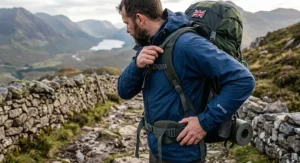
The Berghaus Trailhead 65 sits in a sensible middle ground that a surprising number of buyers actually want: not ultralight, not a budget compromise, just a well-made, adjustable pack from a long-established British brand. The standout feature is the sheer adjustability of its harness system, which lets you fine-tune torso length precisely — a detail forum users repeatedly single out as the reason the Trailhead fits so many different body shapes comfortably straight out of the box.
There’s also a genuine women’s-specific 60-litre version alongside the unisex 65-litre model, both sharing the same core construction and features rather than treating the women’s fit as an afterthought. Based on the spec comparison, this puts the Trailhead ahead of several rivals that simply shrink a unisex pack and call it a women’s fit.
Reviewers consistently describe this as “well made and with lots of adjustability,” and it’s frequently recommended by hiking forums as the pack to buy once you’ve outgrown a starter rucksack but before you’re ready to spend Osprey money.
Pros:
- ✅ Genuinely adjustable harness fits a wide range of body shapes
- ✅ Proper women’s-specific 60L version, not a resized unisex pack
- ✅ Trusted British brand with wide retail availability
Cons:
- ❌ Heavier than premium ultralight competitors
- ❌ Fewer standout technical features than the Deuter or Osprey options
Typically priced in the £70-£100 range (and often found for less in sales), this is a genuinely sensible middle-ground purchase for anyone who wants quality without the ultralight tax.
7. Highlander Novar 60+5 — best lesser-known budget alternative
Most buyers have never heard of Highlander, which is precisely why the Highlander Novar 60+5 deserves a spot here — it’s the classic “quietly excellent” alternative that doesn’t get the marketing spend of the bigger brands. The standout feature is the sheer value proposition: a genuinely usable 60+5 litre capacity, adjustable back system and multiple external pockets, all at a price point that undercuts almost everything else on this list.
What most buyers overlook about budget packs like this is that “cheap” doesn’t automatically mean “poorly made” — Highlander has built a loyal following among UK hillwalkers precisely because its gear tends to outperform its price tag, even if it lacks the refined touches (premium fabrics, ultralight frames) of pricier rivals. Based on the spec sheet, this is a straightforward, honest pack: a floating lid extension, decent padding on the shoulder straps and hip belt, and enough structure to carry a full multi-day kit list without the frame collapsing.
Aggregated sentiment among budget-conscious backpackers is generally favourable, with reviewers noting good value for money and adequate comfort for shorter multi-day trips, though — honestly — verified long-term durability data is thinner on the ground for this brand than for Osprey or Gregory, so if you can’t confirm recent reviews, treat that as a genuine unknown rather than a guaranteed win.
Pros:
- ✅ Exceptional price-to-capacity ratio for a 60+5L pack
- ✅ Solid, straightforward feature set without unnecessary extras
- ✅ Popular with UK hillwalkers seeking genuine budget value
Cons:
- ❌ Less brand recognition means fewer long-term durability reviews
- ❌ Padding and back ventilation lag behind pricier competitors
At under £70, this is the pack for anyone testing the water with backpacking before committing serious money — a genuinely sound starting point rather than a compromise.
Full Spec Comparison: Top 7 Backpacking Rucksacks
| Rucksack | Frame Type | Back System | Weight | Best For |
|---|---|---|---|---|
| Osprey Exos Pro 55 | Peripheral wire frame | AirSpeed suspended mesh | ~950g | Ultralight long-distance |
| Gregory Stout 55 | Steel alloy + fibreglass | Adjustable, gender-specific | ~1.7kg | Best overall value |
| Deuter Aircontact Ultra 50+5 | Wire frame + framesheet | Padded mesh, lumbar support | ~1.9kg | Long-distance comfort |
| Osprey Aether 55 | Reinforced internal frame | AntiGravity-style suspended mesh | ~2.2kg | Heavy/winter loads |
| Vango Sherpa 60+10 | Internal frame | Self-Adjust (SA) system | ~2.3kg | DofE, budget trekking |
| Berghaus Trailhead 65 | Internal frame | Fully adjustable harness | ~2.1kg | Mid-range all-rounder |
| Highlander Novar 60+5 | Internal frame | Adjustable, basic padding | ~1.9kg | Tightest budget |
The pattern across this table is stark: every kilogram you shave off the pack tends to come from either the frame material or the back-panel padding, which is exactly why the Osprey Exos Pro 55 trades some load-carrying comfort for its featherweight build, while the Osprey Aether 55 does the opposite. If you’re still undecided, weigh your typical trip length against your typical pack weight — that single comparison will eliminate at least half this list for most buyers.
✨ Ready to compare current prices side by side? Tap through to check availability before stock runs low.
Practical Usage Guide: Setting Up Your Rucksack Properly
Buying the right pack is only half the job — a brilliant rucksack badly adjusted will still wreck your shoulders. Start by loosening every strap fully before you put the pack on for the first time; load it with roughly the weight you’ll actually carry, because torso-length and hip-belt adjustments only make sense under real weight. Tighten the hip belt first, so it sits directly over your hip bones (not your waist), then adjust the shoulder straps so they hug your back without pulling the pack away from your spine. Load lifters should sit at roughly a 45-degree angle — too loose and the pack sags backward, too tight and it tips your weight forward awkwardly.
For maintenance, give the pack a proper once-over after every multi-day trip: check zip teeth for grit, rinse mud off the base fabric (never machine-wash a framed pack), and re-proof the outer material every season or two with a spray-on waterproofer, since even PFC-free coatings degrade with repeated exposure to UK weather. In the first 30 days, the most common mistake is overpacking the top lid until the whole silhouette becomes top-heavy — pack dense, heavy items (stove, food, water) close to your back and roughly at shoulder-blade height, not bouncing around in an overstuffed lid. The second common mistake is skipping the compression straps entirely; even a half-empty pack sways and throws your balance off on uneven ground if it isn’t cinched down.
Real-World Scenarios: Which Rucksack Suits Your Trip?
Picture three very different backpackers setting off from the same trailhead car park. The first is a university student tackling the West Highland Way on a tight budget, carrying a borrowed tent and a supermarket sleeping bag — for them, the Vango Sherpa 60+10 or Highlander Novar 60+5 makes sense, because neither purchase will sting if student life means the pack gets less-than-gentle treatment.
The second is an experienced hillwalker planning a self-supported ten-day traverse of the Cape Wrath Trail, where every gram compounds over 200-plus miles of bog, scree and river crossings. That’s precisely the scenario the Osprey Exos Pro 55 or Deuter Aircontact Ultra 50+5 was designed for — lighter kit means less cumulative fatigue, and that matters far more on day eight than it does on day one.
The third is a family group splitting communal gear — tent poles, stove, communal food — across several packs for a week’s wild camping in the Cairngorms during shoulder season, where overnight temperatures can still dip sharply. Here, the extra carrying capacity and structural rigidity of the Osprey Aether 55 or Gregory Stout 55 earns its weight, because someone in that group is inevitably carrying more than their fair share.
Rucksack vs Backpack: What’s the Difference?
This is one of the most common points of confusion for first-time buyers, and it’s worth clearing up properly. In everyday British English, “rucksack” and “backpack” are frequently used interchangeably, and for casual daypacks, there’s genuinely no meaningful distinction — both terms describe a bag carried on your back via two shoulder straps. Where the terms start to diverge is in outdoor retail and gear-testing circles, where “rucksack” tends to specifically describe a larger, structured pack — typically 50 litres or more — built with an internal or external frame, a padded hip belt designed to bear real weight, and features aimed at multi-day expedition use.
A “backpack,” by contrast, is often used more broadly to cover anything from a school bag to a laptop commuter bag to a 40-litre travel pack with a clamshell opening — the emphasis is on general carrying convenience rather than load-bearing engineering. Practically speaking, if a product listing describes hip-belt load transfer, torso-length adjustment, or compression straps for a sleeping bag, you’re almost certainly looking at a rucksack in the technical sense, regardless of what the label says. If it’s built around a laptop sleeve, a clamshell suitcase-style opening, and cabin-baggage dimensions, you’re looking at a travel backpack — genuinely useful kit, but not designed for multi-day load-bearing the way a proper trekking-focused rucksack is.
| Feature | Backpacking Rucksack | General Backpack |
|---|---|---|
| Typical capacity | 50-75L+ | 15-45L |
| Frame | Internal/external, load-bearing | Minimal or none |
| Hip belt | Padded, structural | Often absent or minimal |
| Best for | Multi-day treks, wild camping | Day trips, travel, commuting |
The takeaway: don’t assume the word on the label tells you what you’re buying. Check the frame, hip belt and capacity instead — those three details separate a genuine backpacking rucksack from a bag that merely looks similar in a product photo.
Backpack Capacity Explained: How Many Litres Do You Need?
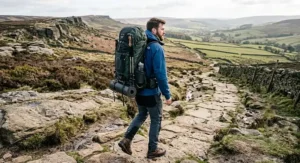
Backpack capacity confuses more first-time buyers than any other spec on the label, largely because manufacturers measure litres inconsistently and a “60L” pack from one brand can genuinely hold less than a “55L” pack from another. As a rough working guide: weekend hikes or a single night of wild camping in good weather need roughly 40-50 litres; week-long treks like the West Highland Way call for 50-65 litres; and extended trips, thru-hikes or winter expeditions typically demand 65-75 litres or beyond, simply to accommodate bulkier insulation and more food.
Here’s what the spec sheet won’t tell you: capacity and comfort don’t scale together. A 65-litre pack isn’t automatically more comfortable than a 50-litre one — in fact, an oversized pack half-filled tends to sway and shift more than a smaller pack packed to capacity, because the load has room to move around. The smarter approach for most UK backpackers is to buy the smallest capacity that genuinely fits your kit list, then rely on external compression straps (standard on packs like the Vango Sherpa 60+10 and Deuter Aircontact Ultra 50+5) to cinch down a half-empty load rather than sizing up “just in case.”
| Trip Type | Recommended Capacity | Example Pack |
|---|---|---|
| Weekend wild camp | 40-50L | Smaller variants of the Gregory Stout range |
| Week-long trek | 50-65L | Osprey Exos Pro 55, Berghaus Trailhead 65 |
| Extended/winter expedition | 65-75L+ | Osprey Aether 55, Vango Sherpa 60+10 |
If you’re torn between two sizes, size down. Nearly every experienced backpacker has a story about the oversized pack gathering dust in the loft after one overloaded, badly balanced trip put them off for a season.
Choosing the Right Hiking Backpack for UK Trails
Picking a hiking backpack for genuinely variable UK conditions comes down to working through a short, deliberate checklist rather than being swayed by whichever pack looks best in the shop window.
- Match capacity to trip length, not aspiration. Buy for the trips you actually do most, not the once-a-year expedition you might one day attempt.
- Prioritise hip-belt fit over shoulder-strap comfort. A well-fitted hip belt carries up to 70% of total load weight, so an ill-fitting belt undoes almost every other feature.
- Check torso-length adjustability, not just overall size. Many packs come in multiple back lengths — get measured rather than guessing from height alone.
- Look for a genuinely ventilated back system. UK humidity turns a solid foam back panel into a sweat trap surprisingly quickly, even on cool days.
- Weigh up ventilation against weight. Suspended mesh systems like Osprey’s AirSpeed ventilate brilliantly but sometimes sacrifice a little stability under very heavy loads.
- Factor in attachment points. Walking pole loops, ice axe loops and external compression straps matter more on Lakeland scrambles than they do on flat towpaths.
- Try before you buy wherever possible. Visiting a proper outdoor retailer and trying a loaded pack beats reading a dozen online reviews, since fit is intensely personal — a point Duke of Edinburgh’s Award expedition guidance reinforces repeatedly for first-time buyers kitting out for an award expedition.
Trekking Pack Essentials for Multi-Day Adventures
A dedicated trekking pack differs from a simple overnight bag in a handful of specific ways that matter once you’re multiple days into a route with no easy resupply. First, look for a genuine sleeping-bag compartment or at minimum a lower zipped access point — digging through a single top-loading cavern for your sleeping bag at the end of a long, wet day gets old fast, which is exactly why packs like the Vango Sherpa 60+10 build in separate bottom access as standard.
Second, prioritise external attachment points for bulky items you don’t want inside the main compartment — a wet tent, trekking poles, or a foam sleeping mat all belong strapped externally rather than eating into your packed volume. Third, hydration compatibility is close to non-negotiable on a modern trekking pack; most UK-sold rucksacks now accommodate 2-3 litre bladders as standard, and a centre-back hose port (found on the Osprey Exos Pro 55, among others) saves fumbling for the tube mid-stride. Finally, a genuinely waterproof or water-resistant base fabric matters more on a trekking pack than almost anywhere else, since it’s the first thing to sit in puddles, wet grass, or a rain-soaked tent porch every single evening of a multi-day trip.
Common Mistakes When Buying a Backpacking Rucksack
The single most common mistake is buying based on capacity alone, ignoring fit entirely — a 65-litre pack that doesn’t match your torso length will be miserable regardless of how many litres it holds. Close behind is assuming a higher price automatically means better comfort; several genuinely mid-range packs on this list outperform pricier rivals for specific body types and load ranges, which is exactly why independent, brand-neutral testing from outlets like Which? is worth cross-referencing before you commit.
A third frequent error is overlooking women’s-specific or plus-size fits when they’d genuinely improve comfort, often because shoppers assume unisex sizing is “close enough.” It rarely is — narrower shoulder width and shorter back length on genuine women’s-specific packs (like the Gregory Stout‘s Amber 54 sibling) make a measurable difference over multiple days. Finally, plenty of buyers skip trying a pack loaded with actual weight before purchasing, relying instead on how it feels empty in a shop — and an empty pack tells you almost nothing about how the hip belt and shoulder straps will behave under 15kg of real kit.
Long-Term Cost & Maintenance
Total cost of ownership on a backpacking rucksack extends well beyond the sticker price. A £70 budget pack that needs replacing after eighteen months of regular use may end up costing more over five years than a £200 pack built to last a decade — the classic buy-cheap-buy-twice trap. That said, the inverse mistake is just as common: paying premium prices for features (ultralight fabrics, minimalist frames) you’ll never actually need for occasional weekend trips.
Ongoing maintenance costs are modest but real: expect to budget for the occasional re-proofing spray (roughly £10-15 every season or two), a replacement rain cover if the original tears or goes missing, and potentially a repair kit for zip pulls or buckle clips on heavily used packs. Packs with metal frames and replaceable framesheets — like the Gregory Stout 55 and Deuter Aircontact Ultra 50+5 — tend to have a longer realistic service life than budget packs with fixed, non-serviceable internal structures, simply because individual components can be repaired rather than the whole bag being written off.
Features That Actually Matter (And Those That Don’t)
Cutting through marketing language is half the battle when comparing rucksacks. Features that genuinely matter: a properly padded, structural hip belt; adjustable torso length; a ventilated back system; and durable, PFC-free water-repellent fabric that holds up to genuine UK weather rather than a curated product-shoot drizzle. These directly affect comfort and longevity on every single trip you take.
Features that matter far less than the marketing suggests: an enormous number of external pockets (most backpackers use two or three consistently and ignore the rest); flashy colourways; and headline capacity numbers measured inconsistently between brands, which make direct litre-for-litre comparisons unreliable without checking actual dimensions. A whistle on the sternum strap is a nice-to-have safety feature rather than a genuine differentiator, and “lifetime guarantees” sound impressive but are only as good as the brand’s actual customer service — Osprey’s All Mighty Guarantee has a strong reputation on this front, which is worth factoring into premium purchases.
Safety, Regulations and Compliance Guide
Beyond fit and comfort, a handful of safety considerations genuinely matter when kitting out for UK trails. A bright, detachable rain cover (standard on most packs here, including the Vango Sherpa 60+10) improves visibility to mountain rescue teams as much as it protects your gear, and a sternum-strap whistle is a small addition that costs nothing but could matter enormously if you’re ever separated from a group in poor visibility. Always carry your pack weight sensibly — a widely cited guideline suggests no more than around 20% of your body weight for sustained multi-day carrying, and exceeding that substantially increases fatigue-related injury risk on steep or uneven ground.
If you’re heading into open access land or upland terrain, familiarising yourself with the Countryside Code is sound practice regardless of which pack you’re carrying, since responsible access and route planning matter just as much as your kit list. For anyone kitting out for a Duke of Edinburgh expedition specifically, note that assessors typically expect a pack that comfortably carries the full required kit list without excessive overloading — another reason sizing correctly, rather than buying the biggest pack available, tends to serve young or first-time backpackers better.
✨ Don’t Miss These Exclusive Deals!
✨ Don’t Miss These Exclusive Deals!
🔍 Take your backpacking kit to the next level with these carefully selected rucksacks. Click through to check current pricing and availability before you head out on your next multi-day adventure — the right pack really does transform how your trip feels.
Frequently Asked Questions
❓ What is the difference between a rucksack and a hiking backpack?
❓ How many litres do I need for a week-long trek?
❓ Is a heavier rucksack always more durable?
❓ Do I need a women's-specific rucksack?
❓ Can I use a normal backpack instead of a proper rucksack for backpacking?
Conclusion
Choosing the best backpacking rucksack for UK conditions really does come down to being honest about the trips you’ll actually take, not the ones you might aspire to someday. If you’re chasing serious mileage and want every gram to count, the Osprey Exos Pro 55 delivers a genuinely impressive weight-to-comfort ratio. If you want the smartest all-round value on this entire list, the Gregory Stout 55 is difficult to beat. Budget-conscious buyers and DofE participants will get years of solid service from the Vango Sherpa 60+10 or Highlander Novar 60+5, while anyone hauling heavier winter or family kit should look hard at the Osprey Aether 55 or Deuter Aircontact Ultra 50+5.
Whichever you choose, prioritise fit over flash — a well-adjusted, correctly sized pack from any brand on this list will outperform a mismatched premium pack every single time. Take the time to load it properly, try it with real weight, and adjust the hip belt before you ever step onto a trail. That’s the difference between a rucksack you forget you’re wearing and one you’re desperate to take off by lunchtime.
✨ Ready to find your perfect trail companion? Check current prices on today’s top pick and get one step closer to your next adventure! 🥾🏔️
Recommended for You
- 7 Best Family Luggage Sets 2026: Matching Suitcases Tested for Real Trips
- 3 Piece Luggage Set 2026: 7 Best Value Picks for UK Travellers
- 4 Wheel Suitcase: 7 Best Spinner Picks for UK Travellers 2026
Disclaimer: This article contains affiliate links. As an Amazon Associate, I earn from qualifying purchases. If you purchase products through these links, we may earn a small commission at no additional cost to you.
✨ Found this helpful? Share it with your friends! 💬🤗
