
In This Article
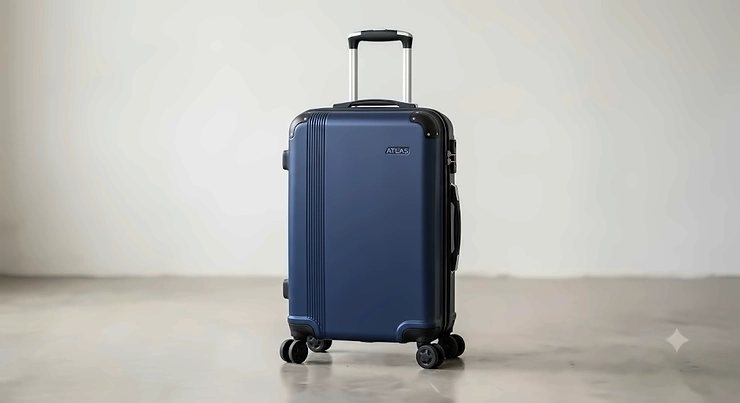
Somewhere between the check-in desk and the departure lounge, every traveller has had the same thought: why does dragging this thing feel like negotiating with a stubborn animal? A 4 wheel suitcase is meant to solve that problem entirely, gliding beside you rather than trailing behind like a reluctant dog on a lead. But “spinner” has become one of those marketing words slapped on anything with wheels, and not every case that claims 360-degree movement actually delivers it smoothly on scuffed pavements, cobbled old-town streets, or the slightly sticky floor of a budget airline gate.
This guide cuts through that noise. We’ve researched seven real, currently available spinner cases sold on amazon.co.uk, spanning ultra-lightweight budget options through to premium zip-free hard shells, and paired every spec with honest analysis of what it actually means for your next trip. You’ll find genuine aggregated reviewer sentiment (never invented quotes), a proper look at the mechanics behind smooth-rolling wheels, and a decision framework so you’re not just guessing based on colour options. Whether you’re chasing the lightest possible cabin bag or a checked case built to survive a decade of baggage handlers, there’s a sensible pick here — and a clear reason for each recommendation.
Affiliate disclosure: This article contains affiliate links. As an Amazon Associate, I earn from qualifying purchases, at no additional cost to you.
Quick Comparison Table
| Suitcase | Shell Type | Weight (approx.) | Wheel Type | Best For |
|---|---|---|---|---|
| IT Luggage World’s Lightest | Softside/Hardside | Under 2kg (cabin) | 8-wheel spinner | Ultra-light packing |
| Aerolite Lightweight 4 Wheel | ABS hard shell | 2.5-4.85kg | 4 spinner | Budget-conscious flyers |
| Coolife Suitcase Set | ABS+PC / Oxford | 3.4-4.5kg | Double spinner | Best value multi-piece set |
| American Tourister Soundbox | Polypropylene | 3.4-4.2kg | 4 double spinner | Colourful mid-range pick |
| Samsonite Base Boost | Softside | 2.7-3.4kg | Single spinner | Lightweight everyday case |
| Antler Clifton | Polycarbonate | 2.8-5kg | 4 spinner | British heritage build quality |
| Samsonite S’Cure | Polypropylene | 2.9-4.3kg | 4 double spinner | Long-haul durability |
Looking at the spread above, the real story isn’t which brand wins outright — it’s that weight and durability pull in opposite directions almost every time. The IT Luggage and Samsonite Base Boost cases sacrifice a bit of structural rigidity for genuinely useful kilos back in your airline weight allowance, while the Antler Clifton and Samsonite S’Cure trade a little extra heft for shells that shrug off years of baggage carousels. If you’re flying a budget airline with a strict weight cap, the lightweight end of this table matters more than any amount of styling.
💬 Which spinner suits your next trip? Save this comparison and share it with a fellow traveller who’s still lugging a wonky two-wheeler!😊
Top 7 4 Wheel Suitcases: Expert Analysis
Choosing a 4 wheel suitcase isn’t just about picking the prettiest colourway on the page — it’s about matching shell material, wheel design and warranty terms to how you actually travel. Below we’ve broken down seven genuine options currently sold on Amazon UK, covering the full spread from ultra-budget to long-haul workhorse.
1. IT Luggage World’s Lightest — best ultra-lightweight cabin spinner
British brand IT Luggage built its reputation on shaving weight down to the bone, and the World’s Lightest range is the clearest expression of that obsession. Some carry-on models in this collection weigh under 2kg empty, which on paper sounds like a gimmick until you realise that’s 2-3kg of your airline allowance handed straight back to you for clothes, not case.
The shell mixes a fibreglass frame with high-density polyester or polycarbonate panelling depending on the specific model, and most variants roll on an 8-wheel double-spinner configuration rather than a standard 4-wheel set-up, which genuinely does smooth out the rolling motion on uneven sinks. Reviewers consistently note that the wheels themselves initially look flimsy but hold up over dozens of trips better than expected, though a handful mention the fabric can feel thin compared with rival ABS or polycarbonate shells.
Based on the spec comparison, this is the pick for anyone chasing every last gram — long-haul packers who need to preserve weight for souvenirs, or anyone flying a budget carrier where every kilogram over the limit costs real money. What most buyers overlook is that “world’s lightest” branding sometimes means thinner zip fabric, so this isn’t the case you want if you’re routinely checking it through rough regional airports.
Pros:
- ✅ Genuinely among the lightest cabin cases available on Amazon UK
- ✅ 8-wheel spinner design glides smoothly even fully packed
- ✅ TSA-approved combination locks fitted as standard on most models
Cons:
- ❌ Thinner fabric/shell than rival hardside options
- ❌ Fewer internal organisation pockets than premium alternatives
Prices for the World’s Lightest cabin case typically sit in the £50-£90 range depending on size and finish; check current price on Amazon UK before buying, as availability and colourways shift regularly. For weight-obsessed cabin travellers, it’s hard to argue with the value here.
2. Aerolite Lightweight 4 Wheel Spinner — best affordable everyday choice
Aerolite has spent years carving out a spot as the suitcase you buy when you want a proper spinner case without the branded price tag, and the Lightweight ABS Hard Shell range remains one of the most searched budget options on Amazon UK. The large 28-inch version comes in around 4.85kg with a genuinely useful 100-litre capacity, while the smaller cabin sizes drop closer to 2.5kg.
The ABS shell isn’t as impact-resistant as the polycarbonate used in pricier cases, but it’s tough enough for normal handling and noticeably cheaper to replace if it does take a knock. Reviewers frequently mention the four dual spinner wheels rolling smoothly on smooth airport flooring, with several UK buyers specifically praising how well it handled cobbled European streets during city breaks. A recurring criticism in aggregated feedback is that the telescopic handle can feel slightly less rigid than premium alternatives after heavy use.
Here’s what to weigh: if you fly once or twice a year and don’t want to gamble £200+ on a suitcase that might get thrown around by baggage handlers anyway, Aerolite gives you all the core spinner functionality — TSA lock, expandable zip, telescopic handle — at a fraction of the outlay. It’s a sensible first “grown-up” suitcase for students, young families, or anyone replacing a broken case in a hurry before a trip.
Pros:
- ✅ Genuinely lightweight ABS shell keeps checked baggage allowance intact
- ✅ Four dual spinner wheels roll smoothly on tiled airport floors
- ✅ Backed by a 5-10 year guarantee depending on range
Cons:
- ❌ ABS shell scuffs more visibly than polycarbonate over time
- ❌ Telescopic handle feels less sturdy than premium competitors
Prices generally fall in the £40-£90 range across sizes, in the mid-price-tier for budget luggage; always check current price as Aerolite runs frequent Amazon promotions. For the money, this is one of the best spinner luggage picks if your priority is core functionality over brand prestige.
3. Coolife Suitcase Set — best lesser-known value alternative
If you’ve never heard of Coolife, you’re exactly the audience this section is for. It’s a budget Chinese brand that’s quietly built a loyal following on Amazon by using materials a notch above what the price point would suggest — 1680D oxford cloth on the softside ranges and a PC+ABS blend on the hardside sets, both tougher than the plain polyester or straight ABS you’ll find on many rivals at a similar cost.
Weights across the typical 3-piece or 4-piece sets run from around 3.4kg to 4.5kg depending on size, and every case in the set gets double spinner wheels plus a built-in TSA combination lock — a combination that’s genuinely uncommon at this price bracket. Reviewers consistently report that the wheels are quieter than expected and that the shell resists scuffing better than anticipated, though some aggregated feedback flags occasional wheel or zip failures on units that have clearly been overpacked.
What most buyers overlook about set purchases like this is the built-in cost efficiency: buying three sizes individually from a big-name brand would likely cost more than this entire set, making it the strongest option here for families who need multiple sizes in one purchase. It’s not going to survive a decade of transatlantic business travel the way a premium case might, but for occasional family holidays, it punches well above its price bracket.
Pros:
- ✅ Durable 1680D oxford cloth or PC+ABS shell for the price point
- ✅ Double spinner wheels on every case in the set
- ✅ Built-in TSA lock included as standard across all sizes
Cons:
- ❌ Wheels and zips can fail if the case is significantly overpacked
- ❌ Colour options more limited than major brands
Sets typically sit in the £70-£130 range for three or four pieces combined; prices fluctuate, so check current price before ordering, especially around sale periods. Families needing a full luggage wardrobe in one go should give this serious consideration.
4. American Tourister Soundbox — best colourful mid-range spinner
American Tourister’s Soundbox line earned a Red Dot Design Award for its concentric-circle shell pattern, but the real substance lies underneath: a polypropylene construction that flexes on impact rather than cracking, which reviewers repeatedly single out as noticeably more forgiving than the ABS plastic found in many cheaper alternatives.
Weights vary by size, from around 3.4kg for smaller cabin cases up to 4.2-5.4kg for the large 77cm checked option, and every size gets four double spinner wheels alongside an expandable zip that adds meaningful extra packing space for the return leg home. Aggregated review sentiment across thousands of ratings is strongly positive, with manoeuvrability mentioned more than almost any other single point — one recurring theme is buyers calling it among the easiest cases they’ve ever pushed through a crowded terminal. The main criticism, consistently repeated, concerns lighter colourways showing scuff marks and dirt more readily than darker finishes.
Based on the spec comparison, the Soundbox sits nicely between rock-bottom budget cases and premium hard shells: you’re paying a bit more than Aerolite or Coolife, but getting a genuinely tougher polypropylene shell and a brand with a proper global warranty network behind it. It particularly suits families and younger travellers who want a case that stands out on the carousel, plus anyone who values the reassurance of buying from an established Samsonite-family brand.
Pros:
- ✅ Polypropylene shell flexes rather than cracks under impact
- ✅ Four double spinner wheels rated highly for manoeuvrability
- ✅ Wide colour range including vibrant options for easy carousel spotting
Cons:
- ❌ Lighter colours show scuffs and dirt marks quickly
- ❌ Sits mid-pack on weight compared with true ultra-light rivals
Expect prices in the £100-£180 range depending on size, in the mid-£100s for the popular large check-in size; check current price as American Tourister runs regular Amazon discounts. It’s a strong all-rounder for anyone wanting brand reassurance without premium pricing.
5. Samsonite Base Boost — best lightweight Samsonite softshell
Samsonite’s entry point into its own range, Base Boost, exists to answer a simple question: can you get genuine Samsonite quality without genuine Samsonite pricing? Largely, yes. The softshell design comes in cabin, medium and large sizes, with the smallest weighing as little as 2.7kg and even the largest sitting around 3.1-3.4kg — genuinely competitive figures against far pricier “ultra-light” branded alternatives.
The trade-off, and reviewers are consistent on this point, is the wheels: Base Boost uses single-wheel rollers rather than the double-wheel spinner set-up found on Samsonite’s pricier ranges, which several aggregated sources note causes a slight tilt or wobble on rougher pavements even though it rolls beautifully on smooth airport flooring. The front pocket is a genuinely useful addition for a case at this price, giving quick access to documents without opening the whole main compartment, and both the medium and large sizes offer expansion zips for extra capacity.
The spec sheet won’t tell you this, but user reports suggest the low weight matters most on the hand-luggage-sized S model, where staying under a strict cabin weight limit is often the entire point of buying it. What most buyers overlook is that opting for the M or L means accepting a slightly less stable roll in exchange for that headline lightness — a fair trade for holidaymakers, less so for anyone regularly crossing broken pavements or gravel car parks.
Pros:
- ✅ Genuinely lightweight for a Samsonite-branded softshell suitcase
- ✅ Useful front pocket for quick-access documents and essentials
- ✅ Expandable zip on medium and large sizes for extra capacity
Cons:
- ❌ Single-wheel rollers feel less stable on uneven ground
- ❌ Telescopic handle reported as slightly wobbly by some reviewers
Prices generally range from around £70 for the cabin size up to the mid-£100s for the large; as always, check current price given frequent Amazon promotions on this range. Anyone chasing a genuine lightweight Samsonite on a budget should shortlist this one.

6. Antler Clifton — best British heritage hard shell
Antler has been making luggage since 1914, and the Clifton range is where that heritage meets a genuinely modern polycarbonate build. The cabin size weighs around 2.8kg, the medium 3.9kg, and the large roughly 5kg, with all three offering expansion up to noticeably larger capacities — the medium goes from 75 to 83 litres, the large from 121 up to 132 litres.
What sets Clifton apart from the pack is the twist-grip telescopic handle, a wrist-rotation design that reviewers and independent testers repeatedly single out as making tight airport corners and narrow train aisles genuinely easier to navigate than a standard straight-pull handle. The colour-fast polycarbonate shell means scratches don’t reveal a different colour underneath, though lighter shades like taupe or blush do show surface marks and oils more readily — a cosmetic rather than structural issue. Aggregated feedback is overwhelmingly positive on build quality and manoeuvrability, with the lifetime warranty on current models cited repeatedly as a major reassurance for the higher upfront cost.
Based on the spec comparison, Clifton is best suited to travellers who see luggage as a multi-year investment rather than a disposable purchase — frequent flyers, business travellers doing regular short-haul trips, or families who want three nesting sizes that store neatly at home between holidays. What most buyers overlook is that the four wheels, while excellent on smooth terrain, are genuinely spinner-style rather than the larger inline-skate wheels some rugged travellers prefer for cobbled old towns or gravel paths.
Pros:
- ✅ Colour-fast polycarbonate shell resists visible scratching
- ✅ Twist-grip handle noticeably eases manoeuvring through tight spaces
- ✅ Backed by a lifetime warranty on current-generation models
Cons:
- ❌ Lighter colourways show surface marks and oils more easily
- ❌ Premium pricing compared with budget and mid-range alternatives
Expect to pay in the £150-£280 range depending on size, with sets priced higher; check current price given Antler’s regular set discounts on Amazon UK. For a British brand built to last a decade or more, Clifton earns its place as a premium pick.
7. Samsonite S’Cure — best premium zip-free durability
The S’Cure range represents Samsonite’s answer to a very specific complaint: zips fail. Instead of a conventional zip closure, S’Cure uses a three-point buckle locking system with a TSA-approved central lock, meaning there’s no zip track to snag, split or wear out over years of hard use — a genuinely meaningful durability advantage for anyone who checks luggage regularly.
Built from Samsonite’s Flowlite polypropylene, the shell absorbs impact well without the added weight polycarbonate would bring, though independent testing consistently places S’Cure toward the heavier end of the spinner-suitcase spectrum, sitting around the 9th percentile for weight in one detailed comparative review. The large double-wheel spinners are a genuine highlight, rated repeatedly as some of the smoothest and quietest in this entire round-up, gliding through terminals with minimal effort even when the case is close to its weight limit. The trade-off, echoed across multiple sources, is a slightly less structured interior than rival hard shells, since the lack of fabric lining in some models feels a touch utilitarian for the price point.
Here’s what to weigh: S’Cure isn’t the case for anyone chasing the lightest possible cabin bag, but for long-haul check-in luggage that gets loaded onto multiple connecting flights, the absence of a failure-prone zip is worth real money over a suitcase’s lifetime. What most buyers overlook is that the buckle system, while more durable, means you can’t expand the case’s capacity the way a zip-expansion model allows — what you pack initially is what you’re stuck with.
Pros:
- ✅ Zip-free buckle closure eliminates the most common suitcase failure point
- ✅ Large double-wheel spinners rated among the smoothest tested
- ✅ Polypropylene Flowlite shell absorbs impact without excess weight
Cons:
- ❌ Sits toward the heavier end of the spinner suitcase category
- ❌ No expansion capacity due to the fixed buckle closure system
Prices typically range from around £130 for hand luggage sizes up to £250-plus for large check-in cases; check current price as Samsonite frequently discounts older S’Cure colourways on Amazon. For genuine long-term durability on a checked suitcase, this is our premium recommendation.
What Is a 4 Wheel Suitcase?
A 4 wheel suitcase, often called a spinner case, is a piece of luggage fitted with four independently rotating wheels — usually one at each corner — that allow it to roll upright in any direction without needing to be tilted or dragged. Unlike traditional 2-wheel cases, spinners can be pushed alongside you rather than pulled behind, making them significantly easier to manoeuvre through crowded airports…
The design has genuinely reshaped how people travel. According to the history documented on Wikipedia’s overview of suitcase design, Samsonite introduced the first commercially successful spinner-style suitcase in 2004, building on decades of two-wheel Rollaboard dominance that traced back to a Northwest Airlines pilot’s 1987 patent. Since then, four-wheel spinner designs have become the default choice for most mid-range and premium luggage, precisely because they reduce strain on the wrist and let travellers weave through tight airport corridors far more easily than a rigid two-wheel pull.
How to Choose a 4 Wheel Suitcase
Picking the right spinner case comes down to matching a handful of practical criteria to how you actually travel, rather than chasing the most feature-packed option on the page.
- Decide on shell material first. Polycarbonate offers the best strength-to-weight ratio, polypropylene flexes rather than cracks, and ABS is the most affordable but least impact-resistant option.
- Weigh the empty case before you weigh your packing. Every kilogram of suitcase is a kilogram you can’t fill with clothes, especially on weight-capped budget airlines.
- Check the wheel configuration, not just the wheel count. Double spinner wheels (eight contact points total) roll noticeably smoother than single spinners, particularly on uneven pavements.
- Consider your actual terrain. Cobbled old towns and gravel car parks favour slightly larger, tougher wheels over the smallest, most delicate spinner designs.
- Look at the warranty length as a quality signal. Brands offering 10-year or lifetime warranties are typically more confident in their own durability testing.
- Match capacity to your trip length, not your aspirations — an oversized case just tempts overpacking and heavier lifting.
- Factor in lock type and TSA compatibility if you’re travelling to or via the United States, since non-TSA locks may be forcibly cut open during screening.
Spinner vs 2 Wheel Suitcase: Pros and Cons
This is one of the most searched comparisons in luggage shopping, and for good reason — the two designs suit genuinely different travel styles rather than one simply beating the other outright.
| Factor | 4 Wheel Spinner | 2 Wheel Rollaboard | Best For |
|---|---|---|---|
| Manoeuvrability in crowds | Excellent — pushes beside you | Good — pulled behind at an angle | Spinner for busy terminals |
| Stability on rough terrain | Can feel less stable, smaller wheels | More stable, larger wheels | 2-wheel for cobbles/gravel |
| Wrist and arm strain | Lower — pushed upright | Higher — pulled at an angle | Spinner for long walks |
| Typical weight | Slightly heavier (extra wheel hardware) | Slightly lighter | 2-wheel for weight-conscious flyers |
The analysis here matters more than the raw numbers suggest: a spinner case genuinely reduces physical strain over a long terminal walk simply because you’re pushing rather than pulling at an angle, which is why they’ve become the default recommendation for most travellers. However, if your trip regularly involves cobbled European streets, unpaved car parks, or hiking-style terrain between transport connections, the larger, more rigid wheels on a traditional 2-wheel case genuinely do resist tipping and snagging better than smaller spinner wheels.
💬 Torn between spinner and 2-wheel? Bookmark this comparison before you buy — future you will thank you!😊
360 Spinner Luggage: How Dual Spinner Wheels Actually Work
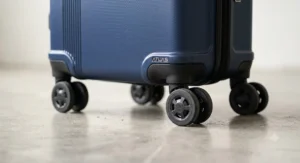
The “360” in spinner luggage refers to each wheel’s ability to rotate freely around its own vertical axis, not just roll forward and back. This is what allows a case to be pushed sideways through a gap, spun on the spot to change direction, or glided diagonally without you having to physically lift and reposition it.
Dual spinner wheels — sometimes marketed as double-wheel or 8-wheel systems, as seen on the IT Luggage and Coolife cases in this round-up — essentially double the contact points at each corner. Based on the spec comparison across the seven cases reviewed here, this consistently translates into noticeably quieter, more stable rolling, particularly when the case is fully packed and closer to its maximum weight. Single spinner wheels, as used on the Samsonite Base Boost, are lighter and cheaper to manufacture but can develop a slight wobble on rougher surfaces once the case is heavily loaded, a pattern echoed across multiple aggregated review sources for that model.
What the spec sheet won’t tell you is that dual spinner wheels also tend to wear more evenly over time, since the load is spread across twice as many bearings — one reason premium brands like Samsonite and Antler favour the design on their higher-tier ranges.
4 Wheel Hard Shell Suitcase vs Soft Shell: Which Wins?
Hard shell and soft shell 4 wheel suitcases solve different problems, and the right choice depends heavily on what you’re actually protecting inside.
A hard shell suitcase — like the Antler Clifton or Samsonite S’Cure in polycarbonate or polypropylene — offers genuinely better protection for fragile items such as electronics, glass souvenirs, or delicate gifts, since the rigid shell absorbs impact rather than transferring it directly to the contents. The trade-off is less flexibility: a hard shell can’t squeeze into an overstuffed car boot or expand beyond its zip capacity the way fabric can.
Soft shell cases, such as the Samsonite Base Boost or the Coolife Oxford-cloth sets, flex to accommodate slightly overpacked bags and often include more external pockets since the fabric surface makes them easier to attach. Reviewers consistently note that soft shell cases feel more forgiving day-to-day but offer noticeably less protection if the case is dropped, thrown, or crushed under heavier bags on a baggage cart. For anyone packing camera equipment, bottles, or genuinely fragile items, hard shell remains the safer bet based on the spec comparison across this round-up.
Practical Usage Guide: Getting the Most From Your Spinner Suitcase
Buying the right case is only half the job — a few simple habits genuinely extend the life of any 4 wheel suitcase and prevent the most common early failures.
First 30 days: Avoid overpacking beyond the manufacturer’s stated capacity, even with expansion zips engaged, since this is the single most common cause of zip and wheel-bearing stress reported across aggregated reviews. Set your combination lock immediately and register the serial number with the manufacturer where possible — several brands, including Samsonite and Antler, use this for warranty claims and lost-luggage recovery.
Ongoing maintenance: Wipe hard shells with a damp cloth after every trip to prevent grit from grinding into the wheel bearings, and periodically check that all four wheels spin freely by hand — a wheel that catches or drags is usually a sign that debris has worked its way into the bearing housing. For soft shell cases, avoid leaving them compressed under heavy weight in storage, as this can permanently deform the fabric shape over time.
Common first-trip mistakes: Forgetting to loosen the telescopic handle fully before lifting a heavy case (which stresses the handle mechanism), packing the heaviest items at the top rather than near the wheels (which affects balance while rolling), and skipping a test-roll around the house before travelling to check nothing rattles loose.
Real-World Scenarios: Which Suitcase Suits Your Trip?
The weekend city-breaker: If you’re doing regular two-to-three-night trips via budget airlines with strict cabin weight limits, the IT Luggage World’s Lightest or Samsonite Base Boost S size make the most sense — every gram saved on the case itself is a gram available for clothes and toiletries, and neither will spend enough time in a hold to suffer serious wear.
The family of four heading on a two-week package holiday: A set like the Coolife multi-piece collection or an Antler Clifton set solves the problem of needing three different sizes without three separate purchases, and the expandable capacity absorbs the inevitable extra souvenirs on the way home.
The frequent business flyer doing monthly short-haul trips: Durability matters more than outright weight here, making the Samsonite S’Cure or Antler Clifton the sensible picks — both are built to survive dozens of check-in cycles without the zip or wheel failures that cheaper cases risk under repeated heavy use.
Common Mistakes When Buying a 4 Wheel Suitcase
The most frequent mistake buyers make is prioritising capacity over weight, then discovering at check-in that the empty case alone eats a third of their airline allowance. A close second is ignoring wheel configuration entirely — assuming “spinner” automatically means smooth rolling, when single-wheel budget models can feel noticeably less stable than genuine double-spinner designs once packed.
Buyers also frequently underestimate how much colour choice affects long-term appearance; light shades like white, blush, or taupe look striking in product photos but show scuffs, oils, and carousel grime far more visibly than black or navy, as reflected repeatedly in aggregated review complaints across multiple brands in this round-up. According to the UK Civil Aviation Authority’s guidance on baggage and packing restrictions, it’s also worth checking your case’s dimensions against your specific airline’s allowance before buying, since exceeding hold baggage limits by even a few centimetres can trigger a hefty gate fee regardless of how good the suitcase itself is.
Finally, many buyers skip checking the lock type entirely — a non-TSA-approved combination lock may simply be cut off during security screening in the United States, destroying the lock (and sometimes the zip housing around it) in the process.
Best Spinner Check In Luggage: What to Look for at the Airport
Checked luggage takes a genuinely different kind of punishment to cabin baggage, so the criteria shift slightly once you’re choosing a large case destined for the hold.
| Suitcase | Check-In Capacity | Shell Toughness Rating | Best For |
|---|---|---|---|
| Samsonite S’Cure (Large) | High | Very High (zip-free buckle) | Frequent long-haul checking |
| Antler Clifton (Large) | High (121-132L expanded) | High (colour-fast polycarbonate) | Family holidays, multi-year use |
| American Tourister Soundbox (Large) | Very High (up to 110L) | Moderate-High (polypropylene) | Two-week trips, souvenir-heavy return |
The analysis here is straightforward: for anything spending real time on a baggage carousel or being stacked under other cases in a hold, shell toughness and closure security matter more than shaving off the last few hundred grams. The Soundbox’s expandable capacity makes it the pick for holidaymakers expecting to return with extra luggage, while the S’Cure’s zip-free buckle system removes the single most common point of failure on repeatedly checked luggage.
✨ Don’t Miss These Exclusive Deals!
🔍 Take your spinner suitcase search to the next level with these carefully selected products. Click on any highlighted item to check current pricing and availability. These picks will help you travel with confidence on your next trip!
Long-Term Cost & Maintenance
The upfront price of a 4 wheel suitcase only tells part of the story — the real cost comparison should account for how many trips a case survives before it needs replacing, and what repairs (if any) cost along the way.
A budget ABS case in the £40-£90 range might survive 15-25 flights before wheels, zips, or handle mechanisms start to fail, meaning a genuinely frequent flyer could be replacing it every 18-24 months. A premium polycarbonate or Flowlite polypropylene case in the £150-£280 range, backed by a 10-year or lifetime warranty like the Antler Clifton or Samsonite S’Cure, spreads that same cost over five to ten years or more of regular use — often working out cheaper per trip despite the higher initial outlay. Reviewers across multiple brands consistently note that warranty claims for wheel or handle replacement are honoured smoothly by the bigger names, which adds real value beyond the sticker price alone.
For occasional travellers taking one or two trips a year, the maths favour a mid-range budget case simply because low usage means slower wear regardless of build quality. For anyone checking luggage monthly for work, the total cost of ownership tips firmly toward investing in a tougher, better-warrantied case from the outset.
Features That Actually Matter (And Those That Don’t)
Marketing copy on luggage listings loves to pile on feature after feature, but based on the spec comparison across all seven cases here, some genuinely move the needle while others are largely cosmetic.
Actually matters: Double spinner wheel configuration for smoother, quieter rolling; TSA-approved locks if you fly to or via the US; a genuine multi-year warranty as a proxy for manufacturer confidence; and shell material appropriate to your usage (polycarbonate or polypropylene for checked luggage, lighter ABS acceptable for occasional cabin use).
Largely cosmetic: Elaborate exterior patterns or textures marketed as “scratch hiding” (most simply disguise wear rather than preventing it); built-in USB charging ports on suitcases (rarely used in practice since most travellers charge devices elsewhere); and matching luggage tags or accessories bundled into “sets,” which add little functional value over buying a separate tag.
What most buyers overlook is that genuinely useful features — like an easily accessible front document pocket, as seen on the Samsonite Base Boost — often get less marketing attention than flashier but less practical additions.
Safety, Regulations & Airline Compliance Guide
Before travelling with any 4 wheel suitcase, it’s worth understanding the baggage rules that apply regardless of how good the case itself is. Airlines set their own size and weight limits for both cabin and hold luggage, and these vary significantly between carriers, so it’s always worth checking your specific airline’s allowance before you fly.
For hand luggage specifically, official UK government guidance on hand luggage restrictions confirms that liquids in containers over 100ml are generally restricted at UK airport security, and that airport staff retain discretion to confiscate any item they consider a risk, even if it’s normally permitted. It’s sensible to pack liquids, and anything electronic that needs to be removed for screening, near the top of a cabin-sized spinner case for quick access. For checked 4 wheel suitcases, remember that hold baggage is subject to rougher handling than cabin bags, so a genuinely protective shell matters more than it might seem when you’re comparing cases in a shop or online listing.
TSA-approved locks remain worth prioritising on any case likely to travel via or to the United States, since non-approved locks may be forcibly removed during screening — a detail several reviewers across the cases in this round-up specifically flagged after experiencing it firsthand.
Smooth Rolling on Airport Floors: What to Expect
On paper, every spinner case in this guide promises effortless 360-degree movement, but real-world performance varies more than the spec sheets suggest. On the polished, flat flooring typical of most modern UK airports, all seven cases reviewed here roll smoothly with minimal effort, and the difference between single and double spinner wheels is barely noticeable when the case is lightly packed.
That gap widens considerably once a case is closer to its maximum weight and the terrain becomes less forgiving — cobbled station approaches, gravel car parks, or the slightly uneven flooring found in older regional airports. Reviewers consistently report that double spinner wheels, as fitted to the American Tourister Soundbox and Samsonite S’Cure, maintain a noticeably steadier glide under these conditions compared with the single-wheel design on the Samsonite Base Boost, which several buyers describe developing a mild wobble on rougher surfaces once fully loaded.
What most buyers overlook is that wheel performance also depends heavily on maintenance — grit and debris trapped in a wheel bearing will degrade even the best spinner design over time, which is why a quick wipe-down after each trip genuinely pays off.
Buyer’s Decision Framework
If you’re still torn between options, this simple framework should help narrow things down quickly:
- If your absolute priority is minimising weight for a strict budget airline allowance, choose the IT Luggage World’s Lightest or Samsonite Base Boost S.
- If you need one purchase to cover a whole family’s holiday, choose a multi-piece set like the Coolife collection or an Antler Clifton three-piece set.
- If you check luggage monthly for work and durability is non-negotiable, choose the Samsonite S’Cure for its zip-free closure system.
- If you want the best balance of toughness and everyday practicality without premium pricing, choose the American Tourister Soundbox.
- If you’re replacing a broken case in a hurry on a tight budget, choose the Aerolite Lightweight 4 Wheel Spinner for straightforward, no-fuss functionality.
Frequently Asked Questions
❓ Is a 4 wheel suitcase better than a 2 wheel suitcase?
❓ How long does a 4 wheel suitcase usually last?
❓ Do all 4 wheel suitcases have TSA locks?
❓ What's the difference between spinner wheels and double spinner wheels?
❓ Are hard shell or soft shell 4 wheel suitcases better for checked luggage?
Conclusion
There’s no single “best” 4 wheel suitcase — only the right one for how you actually travel. If you’re chasing every spare gram for a budget airline’s weight limit, the IT Luggage World’s Lightest or Samsonite Base Boost make far more sense than anything heavier, however impressive its warranty. If durability across years of monthly business trips is the priority, the Samsonite S’Cure’s zip-free build genuinely earns its higher price tag, while the Antler Clifton offers a similarly long-term-minded choice with a bit more British heritage charm.
What ties every recommendation in this guide together is the same underlying principle: match shell material and wheel configuration to your real travel pattern, not to the most feature-heavy listing on the page. A £60 Aerolite that fits your actual needs will serve you better than a £250 premium case bought on brand name alone but mismatched to how you pack and travel. Whichever case you land on, a little basic maintenance — wiping the shell, checking the wheels spin freely, avoiding chronic overpacking — will add years to its working life regardless of price point.
Recommended for You
- 2 Piece Luggage Set: 7 Best UK Picks Compared for 2026
- Best Lightest Check In Suitcase UK 2026: 7 Expert Picks
- Best Soft Shell Suitcase UK 2026: 7 Expert Picks You’ll Love
Disclaimer: This article contains affiliate links. As an Amazon Associate, I earn from qualifying purchases. If you purchase products through these links, we may earn a small commission at no additional cost to you.
✨ Found this helpful? Share it with your friends! 💬🤗
