
In This Article
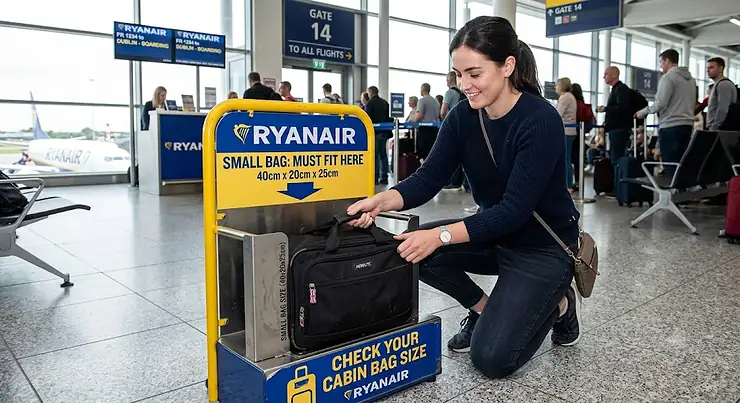
There’s a very specific kind of dread that hits you at the boarding gate: the sight of a metal sizer frame, a queue forming behind you, and a gate agent eyeing your bag like it owes them money. If you’ve ever had to shuffle-walk past that frame praying your bag doesn’t catch on the edges, you already understand why choosing the right underseat cabin bag matters more than almost any other travel purchase you’ll make this year.

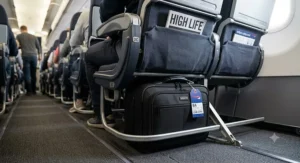
An underseat cabin bag is the small, footwell-friendly bag that slots beneath the seat in front of you, distinct from the larger cabin case that goes overhead. Airlines increasingly treat it as your one guaranteed free item, while everything bigger gets a price tag attached. Get the sizing wrong and you’re paying £30-£60 at the gate for the privilege of learning a lesson the hard way; get it right and you’ve quietly out-manoeuvred the entire budget airline business model.
This guide breaks down seven real underseat cabin bag options — from featherlight duffels to wheeled spinners with a USB port — based on genuine specifications, aggregated customer feedback, and the sort of practical detail that airline websites tend to bury three menus deep. We’ll also walk through underseat cabin bag sizes airline by airline, what actually counts as a personal item bag, and the flight personal item rules that catch out even seasoned flyers. Before you pack, it’s worth cross-checking your airline’s current position against the gov.uk guidance on hand luggage restrictions, since rules on liquids and electronics sit alongside — and sometimes complicate — the size question.
Quick Comparison Table
| Bag | Dimensions | Weight | Price Range | Best For |
|---|---|---|---|---|
| CabinZero Classic Tech 28L | 39 x 29.5 x 20cm | 600g | £45-£60 | All-round reliability across 120+ airlines |
| Cabin Max Metz Stowaway 20L | 40 x 25 x 20cm | 500g | £20-£30 | Tightest possible budget |
| Aerolite Hard Shell 2-Wheel Trolley | 40 x 20 x 25cm | 1.82kg | £30-£45 | Wheeled convenience on a budget |
| Antler Discovery 28L Backpack | 45 x 31 x 20cm | 1.17kg | £70-£90 | Premium build and long-term durability |
| Osprey Daylite Expandable 26+6 | 43 x 33 x 15cm | 840g | £75-£90 | Comfort on long walks through big airports |
| Samsonite Spinner Underseater USB | Personal-item compliant spinner | Approx. 2kg | £90-£120 | Tech-forward frequent flyers |
| Aerolite Ryanair Holdall Duffel | 40 x 20 x 25cm | 450g | £15-£25 | Absolute lowest cost of entry |
Looking at the spread above, there’s a clear pattern: the lighter and cheaper the bag, the more you’re trading away structure and organisation, while the pricier wheeled options add comfort at the cost of a few hundred extra grams that eat into your effective packing weight. If your priority is simply never paying a gate fee, the Cabin Max Metz Stowaway 20L and Aerolite Ryanair Holdall Duffel are built around exact budget-airline dimensions and cost less than a round of airport drinks. If you fly often enough that comfort and durability start to matter more than the sticker price, the Antler Discovery 28L and Osprey Daylite Expandable 26+6 earn their higher price tags back over dozens of trips.
💬 Just one click — help others make better buying decisions too!😊
Top 7 Underseat Cabin Bags: Expert Analysis
Right, let’s get into the bags themselves. Each one below has actually shipped, has real buyers attaching real star ratings to it, and has a specific personality — some are workhorses, some are showoffs, one is basically a £20 bet against Ryanair’s revenue model. Here’s how they stack up.
1. CabinZero Classic Tech 28L — best all-rounder for 120+ airlines
The standout here is coverage: at 39 x 29.5 x 20cm, the Classic Tech 28L squeezes under more airline sizers worldwide than almost anything else on this list. That number — 120+ airlines — isn’t marketing fluff; it’s the actual dimension range most budget and full-service carriers converge on, which means this is the bag you buy when you can’t be bothered cross-referencing five different airline policies before every trip.
Under the hood, it’s 600 denier recycled polyester with a 200 denier recycled lining, which in practice means it shrugs off the scuffs of being dragged in and out of overhead bins and footwells without looking tired after six months. The dedicated laptop compartment fits devices up to 15.6 inches, and — a detail that matters more than it sounds — the bag weighs just 600g empty, so you’re not burning precious weight allowance on the packaging before you’ve even added a toothbrush.
Based on the spec sheet, this is the bag for someone who travels on a genuinely mixed bag of airlines: a Ryanair hop one month, a long-haul carrier the next. Reviewers consistently report that the wide, suitcase-style opening makes packing far less fiddly than a traditional top-loading rucksack, though a recurring theme in feedback is that the shape holds its structure less well once it’s stuffed past about 80% capacity — expect some sagging rather than a rigid silhouette.
Pros:
- ✅ Accepted as personal item on 120+ airlines worldwide
- ✅ 15.6-inch laptop compartment with dedicated padding
- ✅ Extendable warranty — 10 years, up to 25 with brand engagement
Cons:
- ❌ Loses shape and structure once packed near capacity
- ❌ No wheels, so it’s backpack-only for longer terminal walks
At around £45-£60, the Classic Tech 28L sits in the sensible middle of this list — not the cheapest, but arguably the best value per trip if you fly more than two or three times a year across different carriers.
2. Cabin Max Metz Stowaway 20L — lightest budget backpack pick
The Metz Stowaway’s whole reason for existing is 40 x 25 x 20cm — dimensions engineered specifically around the free personal-item allowance most budget carriers use as their baseline. At 500 grams empty, it’s one of the lightest genuinely usable underseat bags you’ll find, which matters enormously if you’re already flirting with a strict 10kg total allowance on a carrier like Wizz Air.
What most buyers overlook about this model is the suitcase-style opening combined with side compression straps — it sounds like a small thing, but it means you can genuinely overpack the 20-litre main compartment beyond what the number suggests, then cinch it back down to a compliant shape before boarding. The front organiser pocket, sized for a tablet, tickets and travel documents, does real organisational work rather than being a token gesture.
This is a bag built for people who fly cheap and fly often: the frequent Ryanair or easyJet weekender who doesn’t want to think hard about luggage, just wants something that fits every time and costs less than a decent meal out. Reviewers consistently note that build quality punches well above the price point, though a handful of aggregated comments flag that the shoulder straps, while padded, aren’t built for genuinely heavy loads over long walking distances.
Pros:
- ✅ Exact 40 x 20 x 25cm sizing for budget-airline allowances
- ✅ Just 500g empty — barely dents your weight budget
- ✅ Comes with a 3-year manufacturer’s warranty
Cons:
- ❌ Straps aren’t ideal for heavy loads on long walks
- ❌ Structure softens noticeably once fully packed
Priced in the £20-£30 range, this is close to the floor for a bag that’s actually designed with airline compliance in mind rather than repurposed from a generic daypack line.
3. Aerolite Hard Shell 2-Wheel Trolley — best hard-shell wheeled option
Here’s the standout: this is one of the only bags on this list that gives you both exact 40 x 20 x 25cm Ryanair-spec sizing and wheels, without ballooning into overhead-locker territory. The hard ABS shell measures 37.5 x 20 x 24cm excluding the wheels and grip, which is the detail airline gate staff actually check — wheels and handles typically get a small amount of tolerance, but it’s worth knowing the true shell size before you argue your case at the sizer.
At 1.82kg empty and an 18-litre capacity, this is heavier than the soft-sided bags on this list, and that’s the trade-off in plain terms: hard-shell protection and rolling convenience cost you roughly a kilo of your weight allowance before you’ve packed anything. The telescopic handle extends to a full metre, and the built-in TSA-approved lock is a genuinely useful inclusion rather than an afterthought, letting you lock the case without conflicting with US security screening.
On paper this means it suits a specific traveller: someone prioritising protection for delicate items — think a laptop, a camera, breakables bought on a trip — over the last few hundred grams of weight efficiency. Reviewers consistently report that the wheels roll smoothly on smooth airport flooring, though a recurring complaint is that the small wheel diameter struggles on cobbles or uneven pavements outside the terminal.
Pros:
- ✅ Hard ABS shell protects fragile items better than fabric
- ✅ TSA-approved combination lock built into the case
- ✅ Wheels reduce shoulder strain through long terminals
Cons:
- ❌ At 1.82kg, it eats more of your weight allowance
- ❌ Small wheels struggle on cobbled or uneven surfaces
Expect to pay in the £30-£45 range — a small premium over the soft budget bags, but one that buys genuine structural protection and rolling convenience.
4. Antler Discovery 28L Backpack — best premium heritage-brand backpack
Antler has been making luggage in Britain since 1914, and the Discovery Backpack is where that heritage shows up in the stitching rather than just the marketing copy. Measuring 45 x 31 x 20cm and weighing 1.17kg, it’s built from fully recycled polyester with what the brand calls “twisted ripstop reinforcement” — in practice, a fabric that resists the small tears and snags that eventually kill cheaper bags after a year of hard use.
The laptop compartment handles devices up to 16.5 inches, a genuinely generous size that covers most 15- and 16-inch work laptops with room to spare, and the rear sleeve slots directly over a wheeled suitcase handle for hands-free carrying through the terminal — a small feature that becomes surprisingly valuable the moment you’re juggling a coffee, a boarding pass and a toddler. Because it’s slightly larger than the strictest 40 x 20 x 25cm budget-airline allowance, this is a bag best matched to carriers with more generous personal-item rules, or to travellers happy to size-check before every flight.
Aggregated customer feedback repeatedly highlights the same handful of things: praise for build quality, the well-organised internal layout, and comfortable straps, alongside consistent comments that this is a bag people expect to keep using for years, not seasons. What most buyers overlook is that the premium price partly reflects the brand’s water-resistant finish and recycled-material sourcing, which won’t matter to everyone but genuinely does extend the bag’s usable life in wetter UK climates.
Pros:
- ✅ British heritage brand with over a century of luggage-making
- ✅ 16.5-inch laptop pocket — larger than most rivals here
- ✅ Suitcase-handle sleeve for genuinely hands-free travel
Cons:
- ❌ At 45cm tall, it exceeds the strictest 40cm airline limits
- ❌ Among the pricier options on this list
Priced around £70-£90, the Discovery Backpack is squarely a long-term investment piece rather than a one-trip solution — the sort of bag you buy once and stop thinking about for the next five years of travel.
5. Osprey Daylite Expandable 26+6 — best expandable comfort backpack
Osprey built its name on hiking packs, and the Daylite Expandable 26+6 borrows heavily from that DNA — the AirScape backpanel uses mesh-covered, die-cut foam that keeps airflow moving against your back, which sounds like overkill for an airport dash until you’re the one power-walking to a connecting gate in a warm terminal. Unexpanded, it measures roughly 43 x 33 x 15cm (17 x 13 x 6 inches), and a genuinely clever 2-inch expansion zip adds a full 6 litres when you need it, converting the bag from a snug personal item into something closer to a small carry-on.
Here’s what the spec sheet won’t tell you outright: independent reviewers who’ve actually run it through the gate sizer at Ryanair-strict airports report it’s marginally over the strictest 40 x 30 x 20cm limit when unexpanded — closer to 43cm long and 33cm wide — yet it consistently passes in practice because the fabric compresses under the sizer’s edges. That’s a real-world nuance worth knowing before you fly, rather than trusting the tape measure alone.
Built with bluesign-certified, 100% recycled materials and backed by Osprey’s lifetime repair guarantee, this is the bag for travellers who value comfort on their shoulders as much as compliance with the rules. Reviewers consistently note the two stretch water bottle pockets and dedicated tech sleeve as small but genuinely useful touches, while a recurring minor gripe is that the expansion zip, while handy, adds a slightly bulkier profile than the sleekest bags on this list.
Pros:
- ✅ Expandable design adds 6L of capacity when needed
- ✅ AirScape backpanel genuinely improves comfort on long walks
- ✅ Backed by Osprey’s lifetime repair-or-replace guarantee
Cons:
- ❌ Slightly over strict 40cm limits unexpanded, by a few cm
- ❌ Bulkier profile than slimmer soft-sided rivals
At around £75-£90, this sits close to the Antler Discovery in price, but earns its place through comfort engineering rather than heritage branding — the right choice if you’re regularly walking long distances between gates.
6. Samsonite Spinner Underseater USB — best tech-forward spinner case
Samsonite’s spinner underseater is built around a single clever idea: four 360-degree wheels instead of the usual two, which means you can push the case alongside you rather than tilting and dragging it — genuinely useful when you’re navigating a crowded departure hall one-handed. The built-in USB port lets you route a cable from an external power bank inside the bag to a port on the exterior, a detail that sounds gimmicky until you’re mid-flight-delay and grateful for 20% more phone battery without unzipping anything.
The padded laptop compartment fits devices up to 13.3 inches — noticeably smaller than the Antler or CabinZero options, so this is a case that suits ultrabook and tablet users rather than anyone carrying a bulkier 15- or 16-inch machine. The front exterior pocket is genuinely well thought through, with a large slip pocket, a zippered mesh section, and dedicated card and pen slots that keep boarding passes and passports from disappearing into the depths of the main compartment.
Based on the spec comparison with the rest of this list, this is the most overtly “gadget-forward” bag here, and it’s priced accordingly. Reviewers consistently praise the smooth-rolling spinner wheels and the confidence that comes with Samsonite’s century-plus manufacturing reputation, though a recurring theme in aggregated feedback is that the smaller laptop sleeve and the added mechanical complexity of spinner wheels make this a poorer fit for minimalist backpack purists.
Pros:
- ✅ Four-wheel spinner design for easier one-handed manoeuvring
- ✅ Integrated USB port for on-the-go charging
- ✅ Backed by Samsonite’s long-standing manufacturing reputation
Cons:
- ❌ Laptop sleeve tops out at 13.3 inches — smaller machines only
- ❌ Heavier and more mechanically complex than fabric alternatives
Expect a price range of roughly £90-£120, making this the most expensive bag on the list — justified mainly if you specifically want wheeled convenience and don’t mind the smaller device compartment.
7. Aerolite Ryanair Holdall Duffel — cheapest lightweight duffel bag
Sometimes the honest answer to “what’s the best underseat cabin bag” is simply “whichever one costs the least and still fits.” The Aerolite Ryanair Holdall Duffel exists for that traveller. At 40 x 20 x 25cm and a genuinely startling 450 grams empty, it’s built from soft-sided fabric with a basic but functional lockable main compartment and an adjustable shoulder strap.
There’s no laptop sleeve, no structured organiser panel, and no pretence of premium materials here — what most buyers overlook is that this simplicity is precisely the point. A soft duffel with no rigid frame compresses more easily under a strict gate sizer than a semi-structured backpack, which in practice means it’s one of the more forgiving shapes when a gate agent is being particular about a millimetre or two.
This is the bag for the traveller doing a genuine one-night city break, someone who’s more interested in avoiding a £40 baggage fee than in having a dedicated pocket for their passport. Where real reviews can be verified, feedback tends to focus on value for money and straightforward reliability across multiple trips rather than any standout feature, which is itself a useful signal — nobody is raving about this bag, but almost nobody is complaining either.
Pros:
- ✅ Remarkably light at just 450g empty
- ✅ Lockable main compartment for basic security
- ✅ Among the cheapest genuinely airline-sized options available
Cons:
- ❌ No laptop sleeve or internal organisation
- ❌ Basic fabric offers little structure or protection
At roughly £15-£25, this is the cheapest bag on this list by a comfortable margin, and for a single weekend trip where budget is the only concern, it does the one job it’s designed for.
Underseat Cabin Bag Sizes: What Every UK Airline Actually Allows
What is a personal item bag? A personal item bag is the smallest category of hand luggage an airline permits free of charge, designed to fit in the footwell under the seat in front of you rather than in the overhead locker. It typically sits alongside — not instead of — any paid cabin bag allowance you’ve booked.
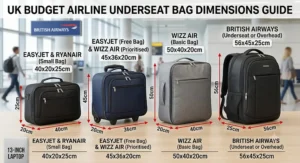
Underseat cabin bag sizes vary more than most flyers expect, and the gap between airlines catches people out constantly. Here’s how the major UK-relevant carriers compare on underseat bag dimensions at the time of writing:
| Airline | Free Personal Item Size | Notes |
|---|---|---|
| Ryanair | 40 x 20 x 25cm | Strictly enforced; sizer at every gate |
| easyJet | 45 x 36 x 20cm | More generous depth and width |
| Wizz Air | 40 x 30 x 20cm | 10kg weight limit strictly checked |
| British Airways | 40 x 30 x 15cm | Included with every fare, no charge |
| Jet2 | 40 x 30 x 25cm | Slightly deeper allowance than most budget rivals |
The most striking thing in that table is the gap between Ryanair’s 40 x 20 x 25cm and easyJet’s considerably roomier 45 x 36 x 20cm — a bag that sails through one airline’s sizer can be visibly oversized for the other. If you regularly switch between carriers, the safest strategy is to buy for the strictest limit you fly with, since a compliant Ryanair-spec bag will virtually always pass easyJet’s more generous check, but not the other way round. For the definitive current position on any given carrier, always cross-reference the CAA’s guidance on checking your baggage allowance rather than relying solely on a retailer’s product description, since airline policies are the ones that actually get enforced at the gate.
Cabin bag dimensions also get measured differently depending on whether wheels and handles are included, which is where soft-sided backpacks quietly have an advantage — a fabric bag with no rigid wheel assembly can flex slightly under a sizer frame in a way a hard-shell trolley simply can’t.
✨ Don’t Miss These Exclusive Deals! 🔍 Take your underseat cabin bag shopping to the next level with these carefully selected products. Click on any highlighted item to check current pricing and availability. These bags will help you dodge gate fees and travel with genuine confidence on your next trip!
How to Choose an Underseat Cabin Bag
Picking the right bag isn’t complicated once you break it into a handful of concrete questions, in this order:
- Identify your strictest airline first. If you fly Ryanair even occasionally, buy to that 40 x 20 x 25cm standard — it’s the tightest widely-used allowance and compliance there means compliance almost everywhere else.
- Decide backpack versus wheeled. Backpacks are lighter and free your hands; wheeled cases add roughly a kilo but save your shoulders on long terminal walks.
- Check the real laptop size you need. A 13-inch ultrabook fits in almost anything on this list; a 16-inch machine narrows your options to the CabinZero or Antler.
- Weigh the bag empty before you buy, not after. A 500g bag versus a 2kg bag is effectively 1.5kg of extra packing weight you get to keep.
- Factor in frequency of use. Someone flying twice a year can justify a £20 duffel; someone flying twice a month should think about the Antler or Osprey’s durability instead.
- Consider structure versus compressibility. Soft, unstructured bags squeeze into sizers more forgivingly than rigid ones, which matters if you tend to pack right up to the limit.
- Read the warranty terms. A 3-year or 10-year guarantee is a real signal of how long a manufacturer expects the fabric and zips to last under regular use.
What Is a Personal Item Bag?
A personal item bag is defined by airlines as the one small item of hand luggage you’re allowed to bring on board at no cost, distinct from any larger cabin bag you may have paid extra for. It’s meant to hold immediate essentials — a laptop, snacks, medication, travel documents — and must fit entirely under the seat in front of you, not in the overhead locker.
The confusion most travellers run into is that “personal item” isn’t a universally standardised size — as the comparison table above shows, it ranges from a snug 40 x 20 x 25cm on Ryanair up to a noticeably roomier 45 x 36 x 20cm on easyJet. Reviewers and frequent flyers alike consistently note that the safest personal item bag is one built to the smallest common denominator you’re likely to encounter, rather than the most generous one.
Flight Personal Item Rules Airlines Don’t Put on Their Websites
Flight personal item rules published on airline websites tend to state a single set of dimensions and stop there, but the practical enforcement is messier — and worth understanding before you’re standing at the gate.
First, weight limits often apply even to “free” personal items, and they’re frequently stricter than travellers expect; Wizz Air’s 10kg cap, for instance, applies to the bag and its contents combined, not just the cabin case. Second, gate staff have discretion: a bag that’s a centimetre or two over on paper may pass if it’s soft-sided and squeezes into the sizer, while a rigid case at exactly the stated dimensions can still be challenged if it looks obviously full. Third, and this catches out even experienced flyers, some airlines only guarantee your personal item allowance if you’ve booked the correct fare tier — a handful of ultra-budget tickets restrict passengers to a genuinely tiny bag that must fit fully under the seat with no exceptions.
According to the Wikipedia entry on baggage sizers, these metal or plastic frames exist specifically because dimension disputes at the gate were common enough that airlines needed a physical, unambiguous test rather than relying on a tape measure and a disagreement. Knowing that a sizer — not a stated number — is the actual test you need to pass changes how you should pack: leave the last 10% of capacity unused so your bag keeps its shape rather than bulging at the edges.
Common Mistakes When Buying an Underseat Cabin Bag
The same handful of buying mistakes come up again and again in aggregated review data and traveller forums:
Buying to the most generous airline’s allowance rather than the strictest one is probably the single most expensive mistake — a bag sized for easyJet’s 45 x 36 x 20cm can be turned away or charged for on a Ryanair flight. Ignoring empty bag weight is another common trap; a heavier structured case eats into a strict 10kg total allowance before you’ve packed a single item, which matters enormously on weight-capped carriers.
Overlooking wheel and handle protrusion is a subtler error — many buyers measure the packed dimensions but forget that wheels and telescopic handles typically get included in the gate measurement, even if a listing quotes the “shell only” size. Assuming a listing’s “airline approved” claim is verified by the airline itself is also a mistake worth flagging clearly: these are almost always self-certified by the retailer based on published dimensions, not an official partnership, so it’s worth checking the current terms on the airline’s own site rather than trusting a product title alone.
Finally, many buyers underestimate how much a bag’s structure affects sizer compliance — a rigid hard-shell case at exactly the stated dimensions has far less room for error than an equivalent soft-sided bag that can compress slightly under pressure.
Underseat Cabin Bag vs Overhead Cabin Luggage
| Factor | Underseat Cabin Bag | Overhead Cabin Luggage |
|---|---|---|
| Typical Cost | Usually free with every fare | Often requires a paid add-on |
| Typical Size | 40 x 20 x 25cm to 45 x 36 x 20cm | 55 x 40 x 20cm to 56 x 45 x 25cm |
| Access During Flight | Immediate, at your feet | Requires standing to reach bin |
| Weight Allowance | Often 7-10kg | Usually 10-15kg or more |
| Best For | Short trips, essentials, budget flying | Longer trips, bulkier packing needs |
The trade-off here is straightforward once you see it laid out: an underseat cabin bag costs nothing extra but gives you meaningfully less room, while overhead cabin luggage roughly doubles your packing capacity at the cost of a paid add-on on most budget carriers. For a genuine one- or two-night trip, the underseat option alone is usually sufficient and saves real money; anything longer than that typically needs the extra volume that only an overhead-compliant case provides. Frequent flyers often solve this by owning both — an underseat bag for short hops, an overhead-compliant case reserved for longer trips where the paid allowance is worth the cost.
Practical Usage Guide: Packing, Maintenance and Your First 30 Days
Getting the most out of a new underseat cabin bag starts before your first trip. When it arrives, pack it out fully once at home and check it against a printed template of your airline’s exact dimensions — most airline websites publish one, and pressing your bag against a printed outline is far more reliable than trusting a tape measure on a squishy fabric surface.
Use compression more deliberately than you might think to. Rolling clothes rather than folding them typically frees up 15-20% more usable space in a soft-sided bag, and packing cubes — while an extra cost — keep a compressible bag from bulging unevenly, which matters directly for passing a sizer check. In your first month of ownership, avoid overloading external pockets specifically; these are the parts of a bag most likely to be checked closely by gate staff because they visibly protrude beyond the main shape.
For maintenance, wipe down fabric bags with a damp cloth rather than machine washing them, since most soft-sided underseat bags use water-resistant coatings that machine washing can strip over time. Zips are usually the first failure point on budget bags — avoid forcing a zip past a snagged bit of fabric, and instead unzip slightly, clear the obstruction, then continue. On hard-shell cases, check wheel axles periodically for grit build-up, particularly if you’ve walked the case across cobbled streets or gravel car parks, since debris in the axle is the most common cause of a wheel seizing up mid-trip.
A common early mistake is assuming a brand-new bag will pass every sizer simply because the listing says “airline approved” — always do your own dimension check against your specific airline’s current published allowance before your first flight, since policies do shift year to year.
Real-World Scenarios: Which Underseat Cabin Bag Suits You?
The weekend city-break regular. If you’re flying budget carriers three or four times a year for two-night trips, prioritise cost and weight over features. The Cabin Max Metz Stowaway 20L or Aerolite Ryanair Holdall Duffel both fit this brief precisely — cheap enough that losing one to airline damage doesn’t sting, light enough to leave maximum room in your weight allowance.
The remote-working digital nomad. If you’re carrying a laptop, chargers, and work essentials on a near-constant travel schedule, durability and organisation matter more than shaving off the last 200 grams. The CabinZero Classic Tech 28L or Antler Discovery 28L both offer proper laptop protection and the kind of build quality that survives dozens of trips a year without falling apart.
The comfort-first long-haul flyer. If your trips involve long walks through big international terminals — think Heathrow Terminal 5 or a tight connection through a hub airport — the Osprey Daylite Expandable 26+6 earns its higher price through genuine back comfort and a bit of flexible capacity for the inevitable extra souvenir. The Samsonite Spinner Underseater suits the same traveller if wheeled convenience matters more to you than backpack comfort.
Problem → Solution: Fixing the Most Common Underseat Bag Headaches
Problem: your bag passes the sizer empty but bulges once packed. Solution: switch to compression packing cubes and resist filling the last 10-15% of stated capacity — soft bags like the CabinZero or Cabin Max models are far more forgiving here than rigid alternatives.
Problem: you fly multiple airlines with different allowances. Solution: buy to the strictest limit you regularly encounter — usually Ryanair’s 40 x 20 x 25cm — since a compliant bag there will almost always clear the more generous limits used by easyJet, Jet2 or British Airways.
Problem: your laptop doesn’t fit the bag you already own. Solution: measure your laptop’s actual case dimensions, not just its screen size, and cross-reference against the compartment sizes listed here — the Samsonite’s 13.3-inch sleeve, for example, simply won’t accommodate a 15-inch machine regardless of how it’s marketed.
Problem: a wheeled case becomes hard to manoeuvre in a crowded terminal. Solution: a four-wheel spinner design, like the Samsonite reviewed above, solves this specific issue better than a traditional two-wheel trolley, since it can be pushed alongside you rather than tilted and dragged.
Problem: you’ve been charged for a bag you believed was compliant. Solution: check your bag’s exact dimensions, including wheels and handles, against the specific airline’s current published policy before you travel — and keep your receipt or product listing as evidence if you need to query a charge with the airline afterwards, since your baggage rights in a dispute over damage or loss are separately protected under the Montreal Convention, as summarised by the CAA.
Long-Term Cost & Maintenance: Total Cost of Ownership
| Bag | Price Range | Expected Lifespan | Cost Per Year (approx., 3-year use) |
|---|---|---|---|
| Aerolite Ryanair Holdall Duffel | £15-£25 | 1-2 years | £8-£12 |
| Cabin Max Metz Stowaway 20L | £20-£30 | 2-3 years | £8-£10 |
| CabinZero Classic Tech 28L | £45-£60 | 5+ years | £9-£12 |
| Antler Discovery 28L Backpack | £70-£90 | 7+ years | £10-£13 |
| Osprey Daylite Expandable 26+6 | £75-£90 | 7+ years | £10-£13 |
The numbers here tell a slightly counterintuitive story: once you spread cost over realistic lifespan, the cheapest bags aren’t necessarily the best value, because they tend to need replacing every one or two years. The CabinZero Classic Tech 28L, Antler Discovery, and Osprey Daylite Expandable all land in a remarkably similar cost-per-year band despite very different upfront prices, simply because their warranties and build quality point to genuinely longer working lives. If you fly more than a handful of times a year, that longer lifespan usually outweighs a lower sticker price.
Features That Actually Matter (And Those That Don’t)
Laptop compartment size matters enormously if you actually travel with a laptop, and barely at all if you don’t — don’t pay a premium for a feature you won’t use. Empty bag weight matters a great deal on weight-capped budget carriers and considerably less on full-service airlines with generous or unstated weight limits. A manufacturer’s warranty length is a genuinely useful proxy for expected durability, since companies offering a 10-year guarantee are implicitly betting their fabric and zips will actually last that long.
On the other hand, marketing terms like “airline approved” carry far less weight than they sound like they should — as covered above, these are almost always self-certified by the seller rather than an official airline partnership, so they shouldn’t be the deciding factor in a purchase. Colour and styling, while understandably appealing, have zero bearing on whether a bag will clear a sizer or survive years of travel, so it’s worth resisting the temptation to prioritise looks over the dimensions and build quality that actually determine whether your bag does its job.
Frequently Asked Questions
❓ What size is an underseat cabin bag?
❓ Can I bring a laptop bag as my personal item?
❓ Do underseat cabin bags have a weight limit?
❓ What happens if my underseat bag doesn't fit the sizer?
❓ Are backpacks better than wheeled cases for underseat bags?
Conclusion
Choosing the right underseat cabin bag comes down to being honest about how you actually travel, not how you’d like to travel. If you’re chasing the absolute lowest cost and fly rarely, the Aerolite Ryanair Holdall Duffel or Cabin Max Metz Stowaway will do the job without fuss. If you’re a regular flyer juggling laptops, long terminal walks, or multiple airlines with different rules, the CabinZero Classic Tech, Antler Discovery, and Osprey Daylite Expandable each solve a slightly different version of that problem, while the Samsonite Spinner Underseater and Aerolite Hard Shell Trolley cover the wheeled-convenience end of the spectrum.
None of these bags are objectively “the best” in isolation — they’re each the best answer to a specific question about your own travel habits. Match the bag to your strictest airline, your actual packing needs, and how often you’ll realistically use it, and you’ll spend a lot less time worrying about gate sizers and a lot more time actually enjoying the trip you packed for.
✨ Ready to stop stressing over gate sizers for good? Check current prices on today’s picks and pack your next trip with confidence!
Recommended for You
- Best Hydration Pack UK 2026: 7 Top Picks Put to the Test
- Best Waterproof Daypack UK 2026: 7 Rain-Proof Rucksacks Tested
- 7 Best Foldable Backpack for Travel Picks in 2026
Disclaimer: This article contains affiliate links. As an Amazon Associate, I earn from qualifying purchases. If you purchase products through these links, we may earn a small commission at no additional cost to you.
✨ Found this helpful? Share it with your friends! 💬🤗
